Zero
Resistance
Method
Enter flow through intuitive micro workouts
First reading edition. Chapter six to come.
My Story
"The maturity of man: that means, to have reacquired the seriousness that one had as a child at play."
Friedrich Nietzsche, Beyond Good and Evil, 1886
01
The Only Thing You Need
You've always wanted to be one of those people who just works out, right? The kind who hears the alarm at six and actually gets up. Who has abs by June. Who can carry every grocery bag from the car in one trip, watermelon included.
Whatever you pictured, I can promise you this book will give you something better. It will make you want to move.
I understand if you don't believe me. I wouldn't have believed it myself, back when I had a drawer full of gym cards I never used. But it's true. When you want to move, you stop dragging yourself anywhere. You move more, you get stronger, and one day you notice you haven't forced anything in weeks.
Now you might worry about what it will take. A gym card. A 5 AM alarm. A coach yelling one more rep into your ear, and a protein shake the colour of pond water. A twelve week plan stuck to the fridge.
You need none of it. The only thing you need is this:
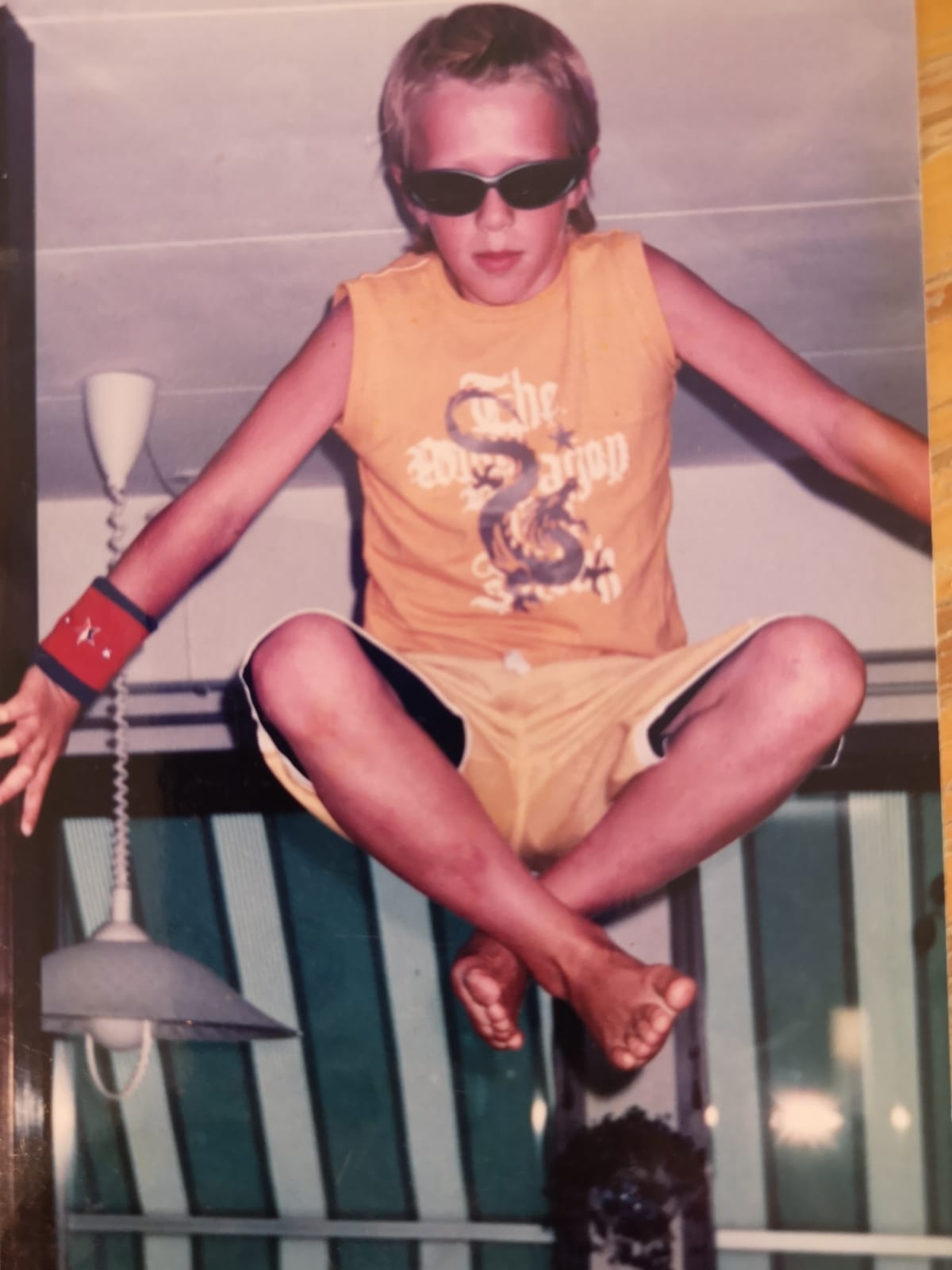
A kid. Watch one for a while and you'll notice something remarkable. They move all day long. They climb, jump, run and hang upside down, and nobody has to tell them to. They don't count reps or check the clock. When they've had enough, they stop, and when the pull comes back, they go again. No plan. No motivational speech. No discipline, at least not the kind we were taught.
You were that kid once. Every one of us was. The body you have right now still knows how to move like that. It was simply told to stop listening, and this book is about learning to listen again.
It will take some practice, like anything worth doing. Mostly, though, it's going to be a lot of fun.
So take a breath, and let's begin.
P.S. The kid in the picture is me, at seven. Any kid, really. The body you were given already knows how to move. The only question this book asks is whether you're willing to listen to it again.
02
The Return to Play
I've let more gym cards die in a drawer than I can count. Each one started with the same burst of motivation and ended the same way: quietly, without a goodbye, buried under receipts. Gone for months. Until one day you open that drawer, and it slaps you right in the face, reminding you of your silly little attempt.
If that sounds familiar, this book is for you. Not because I figured out how to push harder. Because I finally understood why pushing was the problem.
Movement isn't something you force. It's something you remember. And somewhere along the way, I forgot.
To understand how I got here, and why this book exists, I want to start with my story.
If you think about it, movement is the first language we ever learn. Before we speak, before we even think, we move. And if you had seen me as a kid, you’d know I was fluent.
Movement was everywhere. I remember doing everything from karate to golf, from go-karts to football at school and ice hockey in the evenings or just climbing trees in the woods. Whether it was at home, at school, or with friends, play combined with movement was always at the center. It wasn’t about exercise or performance. It was about curiosity. It was about exploring what my body could do.
That’s the kid from the photo on the first page. And like every kid, I was naturally connected to my excitement. I didn’t need motivation or a routine. I never thought, "Is this a productive workout?" I just moved, felt the joy, and acted on it.
But as I grew older, movement lost its spark around the age of 14. Suddenly, social life, appearances, and fitting in became more important than play. And as a teenager growing up in Sweden, that came with its share of influences: partying, alcohol, even cannabis. It started out as fun, but slowly, I drifted away from myself. I lost touch with the playful kid.
At sixteen, I remember one night sitting alone, lighting a joint, and realizing how disconnected I felt. From myself, from nature, from life. I didn’t know it then, but that moment planted a seed. A quiet knowing that something had to change.
Fast forward to a few years later, and somehow, I found myself in Berlin, party capital of Europe. And let me tell you, if you ever want to test how long you can go without sleep, Berlin is your place. For a while, it was fun. The energy, the people, the nightlife. It all felt exciting. Until it didn’t.
And what saved me from going down a destructive path of misuse wasn’t a therapist, a book, or a motivational video. It was…
GOLF.
Yeah, I know. Not the comeback story you expected. But golf became my savior. It reflected me: direction, purpose, and passion. I fell in love with it completely. I left the nightlife behind and dove deep into training. I got accepted into one of Germany’s top golf academies, spent three years studying to become a golf instructor, and even started competing professionally after I finished the program.
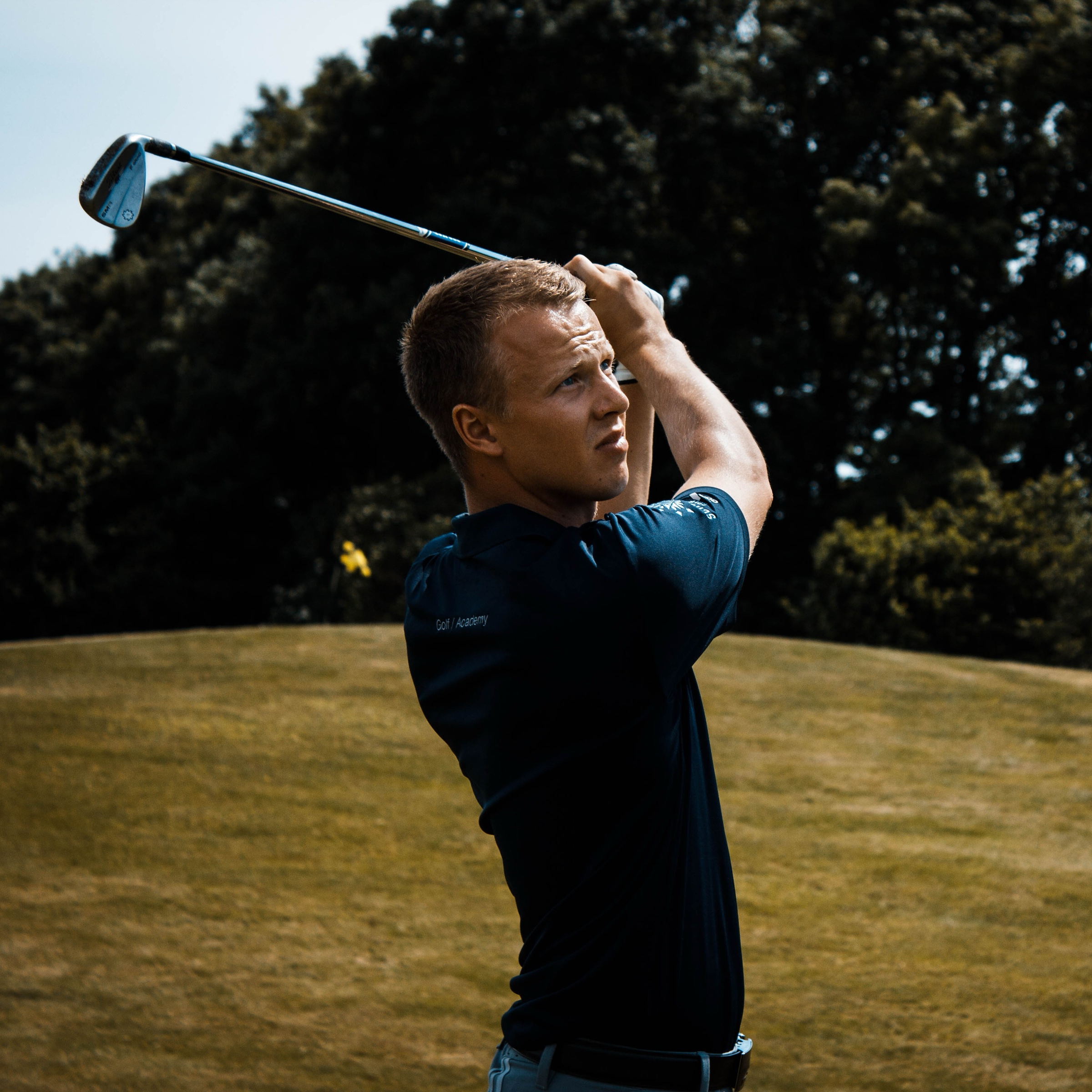
During that time, I was truly devoted to golf. It reconnected me with that kid again, the one who loved to move and explore. But after a few years, I started noticing a pattern. Every off-season, I'd hit the gym hard, gain muscle, feel great... and then lose it all once the season began. There was no spark in me to keep the strength training going, even though I knew it was beneficial.
And here's the thing: I can’t even count how many gym memberships I’ve had. I was forcing myself to train for reasons that didn't resonate with me. To look a certain way. To follow a schedule. Five days a week, same gym, same routine. It worked for a while, until my nervous system burned out and I couldn't sleep well at night. And every time I quit, I wasn’t even really aware of it. It was more like, “Oh, I haven’t been to the gym for six weeks… whatever, I guess I’m busy.” And then it came to an abrupt stop.
One day, some years after my golf education, I was at the gym and suddenly had a realisation. I asked myself: Why am I even doing this? Do I actually enjoy it?
It was quite simple: The joy, play and passion was missing. I started to think about how I could make it more accessible and fun for me, since I didn't really enjoy going to a gym.
One of the first things I did was buy a pull-up bar for home. I started doing small workout sessions, or what I call micro workouts. A few minutes, whenever the urge showed up. Sometimes strength, sometimes stretching, sometimes just dancing to music. Simple bodyweight things, and short enough that there was nothing to talk myself out of. Movements I felt were more fun, and just as effective as the ones inside the gym using the machines.
I didn’t need to push harder or force myself to move. I needed to remember who I actually am. Now things are constantly evolving in terms of my training and I am having so much fun, doing it my way.
03
Why I Wrote This Book
There is something I want to be super clear about. I am not a fitness instructor, an expert or guru. I am simply someone who loves to share the idea that we are creative, passionate beings, that we are the one that has the power within ourselves to choose positive change. You could see me as a bridge, someone who helps people learn to trust their own heart and intuition again, so they can live as who they actually prefer to be.
At the same, I am also witnessing many people stuck inside the ideas of discipline, struggle and forcing change. The Zero Resistance Method is created as a solution for people who wish to experience a state of flow rather than a constant war within one's mind. Who wishes to be naturally creative and to express themselves through movement, in the way that feels most natural and fun to them. This book is about patterns of behaviour and at the same time giving you a method for changing it. Once you start to use the Zero Resistance Method and start to take action on the new ideas and impulses you're getting, it will have the capability to reflect your natural state of being whereby change becomes easier and easier. You will create from the deeper perspective of what passion really is. You will be the reason why you move, and you will realise, you were always enough to be you. Because I realized, the real problem isn’t that people lack motivation or discipline. It’s that we’ve tricked ourselves to lose our connection to joy, creativity and passion. We’ve turned movement into something to achieve, instead of something to experience and to explore.
So let’s recreate ourselves from the idea of that playful, creative child we once were. Let’s take our power back by realizing we are the ones in charge. We can choose change that’s guided by flow, curiosity, and passion. I’m deeply grateful to be on this adventure with you.
04
You Already Can
By now you know my story, and why I wrote this book. Before we go any further, I want you to feel it for yourself.
Close your eyes for a moment and go back to a time when you were a kid, playing a game you loved. Tag in the schoolyard. Climbing a tree. Jumping on a trampoline until someone called you in for dinner. Pick one and stay there for a while.
Now feel it in your body. How does it feel to move and play like that? Let it spread.
Keeping that feeling, open your eyes and do the first movement that comes to mind. A squat, a push-up against the wall, a jump, anything. One or two, no more. Just to feel how it feels.
Pause. Is the feeling still there? Then do one or two more. Pause again, and go once more if you feel like it. Stop when the feeling fades.
Now count them. Six squats? Eight push-ups? Without noticing, you just did a real set, and it felt like play. Nobody made you. There was no plan, no alarm, no coach. That's the kid, still in there. You already have what you need. You always did.
If you're somewhere you can't move right now, mark this page and come back to it.
So why don't we move like that all the time? Why did we stop being that kid? To answer that, we need to take one step back, because it all starts with who you believe you are.
That's where this book begins. Chapter 2 looks at what you were told: who you believe you are, the beliefs you carry about your body, and the gym, the plan and the instructor we think we need.
Chapter 3 gives you the method. A formula you have been using your whole life, especially as a kid, now with a structure you can use on purpose.
Chapter 4 is the practical one. How to set up your movement at home, with what you have, a few minutes at a time.
Chapter 5 brings it home: what it could cost you to stay where you are, and what it means to allow yourself to be.
And chapter 6 shows you the exercises themselves.
So let's start where everything starts. Who are you?
Before you move on
Thank you. That is genuinely useful.
What You Were Told
"A belief is a lever that, once pulled, moves almost everything else in a person's life."
Sam Harris, The End of Faith, 2004
01
Who Am I?
At around twenty-five I moved back to Sweden, after my golf years in Germany and Spain. Coming back, the pull was gone. That path no longer felt like mine. So the obvious choice was a job as a golf teacher, and that is what I took.
Something else had started while I was in Germany. Another layer of questioning. I was reading more about spirituality, wanting to know what I am, where I come from, and why I am even here. Those bigger questions led me to meditation, which became a tool for observing my thoughts and my feelings, and for shifting my state of being into that stillness of zen and flow, just being within myself. Some sessions lasted almost an hour, and in them the connection and harmony were extreme.
But the funny thing is, even if we consciously choose to be in a state of awareness and harmony, the old conditioned reaction can still fire when the right environment comes into play. For example: I was not a harmonized golfer. The truth is, most of the time when I played golf, I was actually mad. I had very high expectations of myself. I wanted to play really well, and when I didn't, I let it out in anger. Cursing, swearing, shouting, showing signs of aggressive behavior, not toward any person, but toward myself. And it's funny if you see the contradiction: that one night you can sit for an hour in total bliss, and the next day you go out and curse.
That means that somehow, even if we choose to be in a state of stillness, there is still something called conditioning. And oh boy, do I have conditioning. But not only me. We all do. We all have conditioning, and that's also a big part of what this book is about. It's to understand our conditioning. And once we understand it better, and once we have a method for working with it, and also against it, to choose different behavior, to choose a different state of being, things start to become easier.
Back in Sweden, the spiritual thread went deeper. You could have called me a seeker. I was learning from different religions, from different spiritual authors, from TV shows, and underneath all of it sat the same motivation: the need to understand who I am.
So I started asking bigger questions. Who am I? Why am I here? What is it that I like to do? What is it that I want to change? What is it that I want to inspire?
When we question, we put ourselves in a more open state of mind. We become more receptive to new ideas that we might have been closing out before. We become less judgmental, and our whole being starts to seek new information, new perspectives. It becomes more experimental. And this is exactly the state we want to be in if we seek change. I think this would be a great starting point for you too, to start to question.
That's why this book starts with the question: Who am I? And the idea is not to think your way to an intellectual answer. The idea is to plant the question within us and let it guide us, instead of trying to figure out something comfortable for the brain to settle on. It's okay not to know.
Ramana Maharshi put it like this: "The thought 'who am I?' will destroy all other thoughts, and like the stick used for stirring the burning pyre, it will itself in the end get destroyed."
The way I read that is that the question is a leader. It clears out the other thoughts, it gives you a reason to move, and once it has done that, it burns up with the rest. You are not meant to keep it. You are meant to use it.
And here's the thing. A question like that isn't really answered in the mind anyway. It's answered in what you do. Think about it, being a human in physical reality comes down to action, to which steps we actually take. We can think good thoughts, and we can have good feelings, but do they really matter much if we never act on them? It feels, to me, like part of our purpose as humans is to take physical action. So the question doesn't ask you to sit and ponder it. It asks you to move, to try things, to notice what feels like you and what doesn't. The question opens you up; the action is how you explore it.
Most people are after something similar. To feel healthy. To experience a state of flow and harmony, where life feels lighter, especially when it comes to movement, exercise, and our bodies. That is what this book is about.
Now, as I have been digging into writing this book, I also had to question a lot of my own conditioning, the ones I had learned growing up, but also the ones I have picked up along my spiritual journey. This is what makes this book so fun, because it has both worlds. It has science, and it has metaphysical ideas...and it has my own experience of actually walking through this, which you get to benefit from.
Everything I use in this book is not to prove what is right or wrong. I only use something if I believe it will help you. And you are the ultimate decider of what is best for you. I only ask you to be open-minded, and to play with the different ideas and tools that you'll be given within this book, because it's through that play, through the idea of taking physical action and playing with it, that we actually learn. So why are you here? Maybe you want to lose twenty pounds. Maybe you want to build muscle, or move without pain, or finally feel at home in your body. Maybe you're not even sure yet. All of those are welcome. But underneath whatever brought you here, I'd guess there's something simpler: you want to improve the quality of your life. And the quality of your life lives in your physical actions and your state of being.
02
Beliefs
Once I dug deeper into the quest to know myself, I stumbled upon an interesting source, a supposed extraterrestrial being named Bashar, who claims he is channeling himself through a human being called Darryl Anka. Now, for a lot of people this may seem absurd, and for me, it sounded totally interesting. What's important to know here is that whether he's a real extraterrestrial or not, I've left that question open. I don't have a yes, and I don't have a no. But the information he was sharing was what caught my attention. One piece in particular stood out, a simple five-step formula for living with less resistance and more flow. It's called the Follow Your Excitement Formula. I'll simply call it the Formula, and Chapter 3 is where we go through it. I put it to the test in my own life, and it worked so well that it became the backbone of how I view my life and how I take action. It's what I believe is the most profound tool for anyone who seeks to live a rich life based on their own authentic expression.
Right now, though, I want to talk about something interesting he brought up: the idea of a belief.
He basically says our whole physical existence is built upon beliefs. That we are made up of them, and that they quietly run the show behind the scenes: shaping how we feel, how we think, and what we decide to do.
Let me make that more concrete, because it sounds abstract until you see it in action.
When I started my golf education in Germany, I was surrounded by players who were better than me in every measurable way. It never occurred to me that I didn't belong there.
Somewhere deep down I already knew I could do this. I didn't have the game yet, that was obvious to everyone including me, but the lack of it didn't make me shrink. It fired me up. I simply knew I could get as good as the good players.
Now play the opposite version with me. Same golf club, same scores, same me. Only this time I walk in believing "everyone here is better than me, I don't really know what I'm doing." What happens?
I think I'd have shrunk. The gap between me and the good players would have looked like proof I didn't have it, instead of a puzzle worth solving. I'd have trained less, asked less, wanted it less. And somewhere in those three years I'd have found a reasonable-sounding excuse to stop, the way I'd stopped things before. The golf club was identical. Same teachers, same range, same students, same lousy scores from me. Only the lens would have changed, and the professional career I told you about at the start almost certainly wouldn't have happened.
That's what he means when he says beliefs navigate our lives. They don't just sit in your head as opinions. They actively shape what you notice, how things feel, and what you do next. One version of me saw a place to learn and get better. The other would have seen a room full of people who already knew more than him. Same club, same day. Both versions completely convinced they were seeing reality.
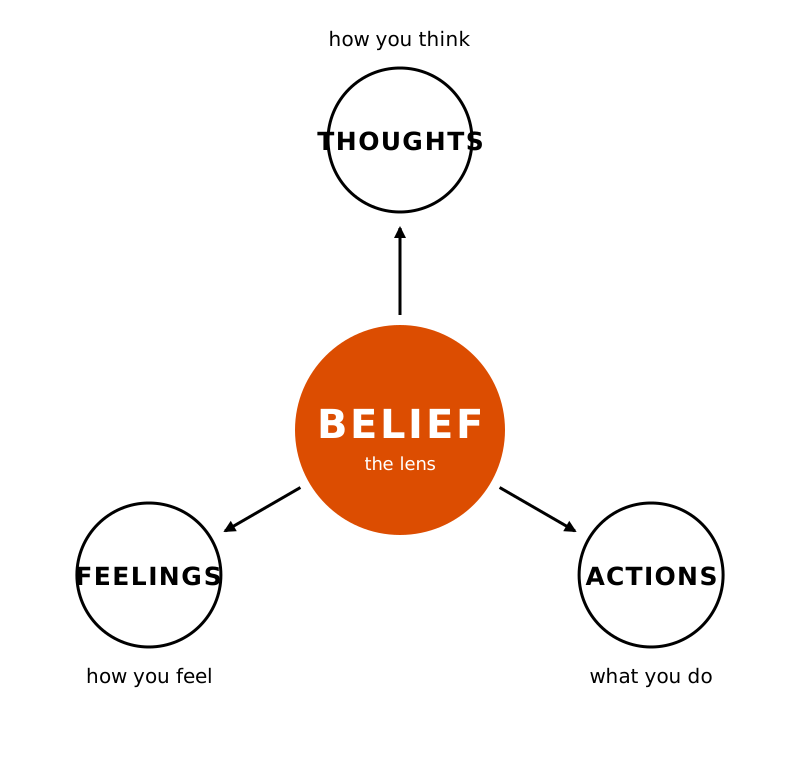
He says that life, in and of itself, has no built-in meaning. That sounds cold at first, maybe even scary. But what he's really saying is that we are the ones giving it meaning, through our beliefs. Every situation you walk into, you bring a lens with you, and that lens decides what the situation means to you. Two people can go through the exact same event and walk away with completely different stories about what just happened. The event didn't change. The lens did.
And this leads to something really practical. If our beliefs are shaping our experience from the inside out, then trying to fix our lives by only rearranging things on the outside is like standing in front of a mirror and trying to fix your hair by wiping the glass. You can polish that mirror all day. The reflection won't change until you change what's standing in front of it. You have to change the image first, your inner state, your beliefs, for the reflection to shift.
That's the foundation everything in this book rests on.
Now, I dug into this work because I realized I wanted to change. I wanted a better income, a better job, better behavior. I wanted to find a partner, and so on. There were so many things that I wanted, and I believed I needed to change. I even got so far that I was listening to affirmations, putting on sleep headphones to play them while I slept: "I am rich! I am rich! I am abundant"
But what's fascinating about looking back on my journey, and everything I wanted to change, is what I eventually stopped doing. I stopped affirming.
Let me explain what I mean, because this might sound like the opposite of what you'd expect.
For a long time, I was chasing change through words. Repeating things to myself, trying to convince my own mind that I was already the person I wanted to be. And for a while it felt productive, like I was doing the work. But at some point I noticed something: the more I affirmed, the more I was confirming that I didn't already have what I needed. Every "I am enough" was quietly saying "because right now, I'm not."
Years later I found out psychologists had run this as an experiment. They asked people to repeat "I'm a lovable person" and measured how they felt afterwards. The people who already felt good about themselves got a small lift. The people who didn't felt worse than the ones who said nothing at all. The affirmation backfired hardest on exactly the people reaching for it. Which is what I had felt happening, without having a name for it.
Here's where it shifted. Through everything I learned from Bashar, and through my own experience, I started to land on a much simpler idea: what if I'm already supported? What if, in every moment, I already have exactly what I need?
Think about today. You woke up. You're breathing. You're reading this book. Whatever challenges you're facing right now, you're still here, still moving through them. You've made it through every single difficult day you've ever had, a hundred percent success rate so far. Not because you affirmed your way through them, but because something in you kept going and you always had what you needed, to keep on.
If that's true, and it is, then why would I need to stand in front of a mirror and convince myself I'm supported? I already am. The evidence is my entire life.
And once that landed for me, it stopped mattering so much what I had, what I'd achieved, or where I was compared to where I thought I should be. What started to matter was simpler: how do I choose to act, right now, in this moment? Am I acting as the person I prefer to be, or am I acting from the old story?
That question became my real ground. Not the affirmations. Not the goals. Just: am I being who I actually want to be, right now?
I think that's a solid place to stand. And it's the direction everything in this book is pointing toward.
So if we take that and frame it through the lens of working out, what are some strong pillars of different beliefs we can stand on, so that we find ourselves actually moving? Here are some examples of what I believe can be a strong foundation:
I am someone who works out.
I am strong.
I am movement.
I am fluid.
I am flexible.
I am resilient.
So what do you feel as you actually read those words? Something I've come to understand: who you are isn't really what you think you are. It's how you respond in a real moment, when life is actually happening. So let me put you to the test right now. Reading those beliefs, did they feel true? Or did you notice a resistance somewhere in your body?
Either way, notice this: you felt something before you decided anything. The belief moved faster than your thinking did. That right there is the whole mechanism. A belief predicts how you'll feel when you meet a situation, often before you've had a single conscious thought about it.
There's a section in The Journal where each of those six is defined, and where you can find out which one fights back hardest.
And what fascinates me is that when I went looking on the other side, the scientific one, it describes this exact thing, just in different language.
Science doesn't use the word "belief" in the same poetic way the spiritual world does, but it keeps landing in a strikingly similar place.
One of the leading ideas in modern neuroscience is that the brain isn't a passive camera simply recording what's out there. It's more like a prediction machine. It's constantly guessing what reality is about to be, based on everything it already expects, and a lot of what you "see" and feel is actually that prediction. In other words, your beliefs shape your experience before the experience even arrives. A belief is exactly that: a deep, standing prediction about yourself and the world.
And it doesn't stop at thoughts and feelings. It reaches into the body itself. When someone takes a sugar pill but truly expects relief, their brain can release its own natural painkillers. Not imagined relief. Measurable, chemical relief. The expectation alone changes the physiology. This is the placebo effect, and it's one of the most well-studied phenomena in medicine. Science is careful here, by the way: it shows up strongest for things like pain, fatigue, and mood, not as a claim that belief cures everything. But the fact that it works at all tells us something remarkable: a belief isn't just a thought sitting in your head. It's an instruction your body actually follows.
Both are pointing at the same thing: a belief works like a prediction that shapes your reality from the inside out. If I believe I'm stuck and nothing will change, I'll feel accordingly, and I won't have much pull to move. If I believe I'm heading in a good direction, the energy comes more naturally. Same engine, whether you call it metaphysics or neuroscience.
And once you see that, the next step becomes clear. Not repeating a nicer story to yourself. But questioning the old one honestly, and then acting against it. Small, concrete, physical action that contradicts the old story.
So if you were someone who believed "I am NOT someone who works out," you could easily contradict that right now by dropping to the floor and doing two push-ups. Because that's what a person who works out does. They move. And two push-ups is enough to contradict the belief. This is the reason I love this work. Because first, we consciously choose to learn more about our beliefs (awareness), and then we consciously choose to change them, in accordance with who we prefer to be. That's also why I created The Journal: a companion to support you in taking action.
What's important to understand is that we have to make a distinction between what a belief is and what a neural pathway behavior is. Because a belief can change in an instant. Actually, when a belief doesn't make sense anymore, you drop it. But even if the belief is gone and has changed, we still have our conditioning, our behaviors, and our conditioned reactions within the body and the brain: the neural pathways.
I'll give you a real example. This summer I've been playing golf again, and my focus has been completely different from before. I'm focused on my inner state, on how I talk to myself, how I carry myself on the course. I know I'm not the person anymore who lets a round get trashed by anger. That belief is gone. I dropped it.
But here's the thing. There were still moments where I felt the frustration rising. A bad shot, and somewhere in my body the old fire started to build. Not because I believed in it. Not because I thought anger would help. Just because I have years of cursing wired into my system, and that wiring doesn't disappear the moment the belief does.
The difference is, this time I noticed it, and I chose not to act on it. The frustration came, and I let it pass. That old pathway will take time and practice before it fully fades. But the belief? The belief was already gone. And that's the distinction worth understanding.
So you might find yourself in a strange spot: you've genuinely changed your mind, "okay, I actually can be someone who moves", and yet the old pattern still tugs at you. A lot of people read that tug as proof the change didn't work, and they give up right there. But it's not failure. It's just the pathway taking a little time to catch up to the belief.
The most important part is to know the belief more consciously and to consciously prove that the belief is not true. When we do that many times, with small, small wins here and there, we'll create change that is fast, lasting, and long-lived. I'll go deeper into this in Chapter 4 and 5, and I also have science supporting what I teach.
This is good news, because the truth is, I don't believe we need big fitness goals to get moving. "I'm going to lose 20 pounds," or "I'm going to gain a lot of muscle." Those aren't bad things to want. But they're results, not starting points. Let's not focus on the result; let's focus on the action. If we are focused on the action, if we are aware that action creates change every day, the result will come on its own. We never have to chase it. We just need to start somewhere very, very small.
This is exactly what I did when I started doing my micro workouts. I just did five minutes here and there, and after a few months, it was the easiest thing for me to choose working out every day. And as my body grew more resilient, the workouts became longer and more intense.
Using the whole Zero Resistance Method, we are in a sense "attacking" our comfortable mind from two directions:
- We loosen up the fixed idea of who we are and what the world is.
- We constantly prove that the old beliefs aren't true, through action.
When we put this lethal combination together, we allow ourselves to create change. And once again, that's fun! Right?
03
Trust Your Knowing Over External Authority
When I started my education to become a golf teacher, I was stationed at one of Germany's top golf clubs. The club had a teacher who is genuinely famous in Germany. He's written many books, has a successful YouTube channel, more than thirty years of experience, and he's an extraordinary person all around.
So naturally, since he was my master and my teacher, he was the first person I went to for my own game. Because when I started the education, the truth is I wasn't any near the real good players. My striking was a problem. I didn't hit it far and most importantly, I wasn't shooting good scores. I knew something had to change.
When I went to him, he taught from his own philosophy, built on his own beliefs. For example, he believed that ultimately it's the golf club that hits the ball, and the club just needs to arrive from the right direction. If the club comes in correctly, you're good. What the body does along the way doesn't matter so much; as long as the club arrives right, there's no need to look too closely at the body.
I had my lesson with him. He showed me what he believed I needed to change, and I made the change right there. I could do it consciously, in the moment. But when I got home and started analysing everything, I realised I wasn't actually happy with the answer he'd given me.
The thing is, I'd already been studying my own swing, already been hunting for new information. On some deeper level I understood that the best players in the world were doing something with their motion that I wasn't, and I wanted to know what that was. I wanted to learn that movement. He told me the motion of the body didn't matter, as long as the hands, the arms, and the club arrived correctly at the ball.
I didn't believe him. So during my first off-season, I decided not to follow his advice and to go looking for my own answers instead. I found them, information that went much deeper into the motion of the body, the hips, the spine. I started to rebuild my swing using what I had found.
I did it exactly the way I described earlier: with small, small efforts, every single day. I practised in the shower. In the kitchen. In the elevator. It didn't matter where I was, especially if there was a mirror nearby. I was obsessed with grooving the new motion. Best part? It worked. Over those four months I completely changed my swing, until my motion finally looked like the way the professionals actually use their bodies.
What am I really trying to say here?
Sometimes we buy into the idea of right and wrong, into the "approved" answer we're supposed to follow. On paper, I should have just trusted my teacher. He knows better than me in almost every way, and following the person with more experience, more recognition, more authority looks like the obviously right thing to do. In this case, though, I felt there was something more to it. I didn't trust what I was handed, even though, from the outside, trusting him would have seemed like the correct move.
Here's the question worth sitting with: why does following the expert feel so automatically right? I think it's because we've been taught there's one fixed, correct way out there somewhere, and that someone else is holding it. We go looking for whoever has it, and we accept it without checking in with ourselves first.
Let me be clear: seeking new information is a good thing. I did it myself. I went looking, I studied, I found answers that changed my game. The issue isn't the seeking. The issue is what happens when the information arrives. Do we automatically believe it because of who said it? Or do we pause and feel whether it's actually true for us?
There are really only three questions worth asking when new information lands, no matter how experienced or famous the person delivering it:
Does this resonate with me?
Does it make me feel alive and excited?
Do I feel this will actually help me on my own path?
If the answer is yes, take it and run with it. It doesn't matter if it came from a world-famous coach or a stranger on the internet. If the answer is no, let it go, even if the person has thirty years of experience and a YouTube channel.
04
Do You Need a Gym?
I remember when I first started going to the gym in my teens. Not really knowing anything about strength training in particular, I was obviously drawn to the machines. Having that experience of going from machine to machine, well, firstly I would say it felt rather automatic and quite slow. Not to mention that you sit in a padded chair, one muscle working while the rest of you rests. The experience was not really what I was used to if we compare it to any athletic sport where the whole body is activated. The contrast to doing sports in general is quite big, compared to going to a gym and sitting in a padded chair. Now, I also realise that the "standard" gym has advanced and expanded into more variety of movement. You can do anything from different classes such as spinning to yoga, and the list goes on. Which I think is a step in a fun direction and can definitely brighten the whole gym experience.
So, do you need a gym?
Up to you to decide, but I would reckon you really need one if you aim to be a bodybuilder or a professional athlete. Let me explain why I believe you don't need one, if you are anything like me and simply want a strong body without any health issues.
The gym opens up for comparison
Not because the gym is doing anything wrong. But because it creates an environment for comparison. You see other people, where they are in their journey, which weights they're lifting, how they move. Without even meaning to, you start measuring yourself against them. Their body against yours. Their strength against yours. Their confidence against yours.
That's not the gym's fault. That's actually yours. If you can overcome that and just be yourself, know your own boundaries and keep to them, I would say you have come a long way.
That being said, it's not the environment that creates the comparison. But it does give it a stage.
It has also impacted me, both in a positive way and a negative one. For example, I had friends who were able to change their appearance and get stronger and bigger, and that was also a motivation for me to start. Even if I was inspired and motivated, it wouldn't last though. But it made me want to try it.
On the negative side, the comparison to the more experienced gym goers also led me to overtrain. Always thinking I needed to follow the plan and pump until the battery was completely empty. I would say that comes from the no pain, no gain culture, which you obviously will find in a gym.
It's on the walls, in the culture, sometimes in the trainers themselves. Push harder. One more rep. Don't stop. The whole environment is built around the idea that suffering is the price of progress. Not every gym, and not every trainer. Plenty of them know better. The culture around the place, though, still leans that way. And I have actually seen my share of people getting injured simply from overtraining or taking on too much weight. It's quite common in my experience.
Discomfort is good and it's part of growth. When a muscle is working hard, when your breath gets heavy, when you feel the effort in your body, that's your system adapting. That simply means you are putting in the effort and your system is adapting.
Though, pain is not that. Pain is a warning. It's your body clearly communicating that something needs to change, not in a week, not after the set, now. Ignoring that signal doesn't make you strong. On the contrary, it can lead to injury. And an injury you could have avoided by listening is not worth the extra rep, in my opinion.
Something else I have witnessed inside the gym is the imbalance in how women and men do their strength practice. It's so common to see: women working almost exclusively on glutes and legs, men locked onto biceps and chest. It's not that those muscles don't matter. And it's surely better to train some parts of the body than nothing, but we all benefit from working the whole body, not just some parts. The idea that a woman isn't beautiful if she is toned is just one viewpoint. I personally think it's beautiful to see some athleticism in the upper body of a woman, and if you are a woman who likes to train the upper body but doesn't because of how it might look, I encourage you to do it.
And that brings me to the last part, which I believe many buy into:
The gym doesn't make you healthy
Health isn't created from the outside. Walking through the doors of a gym three times a week doesn't automatically equal health, any more than sitting in a garage makes you a car. Health isn't something you collect from a building. It's something you carry with you, generated from the inside, reflected on the outside. As we've already explored in this book, your inner state creates the reflection. If you walk into the gym from a place of fear, pressure, or self-judgment, that's what your body absorbs, no matter how many reps you do. To me, health equals harmony and acceptance within one's self. And harmony isn't built by going somewhere. It's built by being someone, the version of you that moves from a place of peace rather than pressure and fear.
So is the gym good or bad?
It's completely neutral. And it definitely has the potential to be a place where movement is expressed from passion and play. Just keep in the back of your mind that if you walk in with joy, curiosity, and a genuine love for what you're doing there, it can be a wonderful place. Some people thrive in that environment, and if that's you, keep doing what you do. If you have tried it, maybe many times like me, and there is no excitement there, well, you don't need it. So drop it and explore something new.
05
Do You Need a Plan?
I don't know how many times I've decided to change something because I was sick and tired of how things were, and my first thought was always the same. I need a plan. I need to wake up at this time. I need to do this much each day. I need to be there by this point.
The truth is, if you're the kind of person who can set a goal, make the plan, and follow it point by point, congratulations. I genuinely believe you're unique. If you're anything like me, though, you've had many motivation bursts. "Now I'm going to do it. I'm waking up at 6:00 every morning, and I'm going to the gym four times a week." And so on, and so on.
Looking back at all of those bursts now, I just laugh. Not because it's wrong to have a plan, but because I've come to realise those plans were never really the thing that created positive change in my life.
Don't get me wrong, I'm not against planning. I just have a slightly different way of looking at what a plan really is.
A plan, they say, is a roadmap from point A to point B. The catch is that life doesn't always follow Google Maps. You can plan to train four times a week at 8 AM sharp, and then Monday shows up with a sick kid, a meeting you forgot to put in the calendar, and a sore throat of your own. Our conscious mind loves to plan, but it can't predict how we'll feel tomorrow, or what curveballs life will throw next.
I want to be clear that plans are not the enemy. Information from a trainer, a doctor, a rehab specialist, that can be genuinely valuable. Having a plan was never the issue. Believing I had to follow it exactly, or not at all, that was the issue.
Because that's the trap most people fall into. Life happens, the plan breaks down, and instead of adapting, we stop completely. And then we think, I lost the plan, so now I don't know how to move.
Let's expand the definition a little. A plan is traditionally seen as the fastest route from A to B. But what if point B was never the point? Everything in between, the experience, the discovery, the wrong turns, that might be where the value actually lives.
So how do we actually change the viewpoint, and with it, our actions? We stop trying to improve the route and start improving the experience. When the doing itself gets better, we do it more, without needing to be pushed.
One of the biggest mountains I have ever moved was the winter I spent rebuilding my golf swing, and the strange part is that I never had a practice plan. Not once. No schedule, no "three sessions a week," no calendar. I just practised because I enjoyed it. I saw progress. I solved problems. And that pull was so strong that no plan could have kept up with it anyway.
I remember one night in particular. I'd been working on a new movement pattern for weeks, and that evening, everything clicked. I was hitting balls, filming my swing, watching it back on the monitor, and suddenly, there it was. I couldn't stop. I hit ball after ball, watched the footage over and over, for hours. I went home past midnight, stunned, amazed at the change that had appeared.
No plan put me in that room. No schedule kept me there past midnight. What kept me there was the experience itself, the enjoyment, the discovery, the problem being solved right in front of my eyes. Point B, the better swing, arrived almost as a side effect. The in-between was the whole thing.
I think when we drop the rigidity and invite a bit of flexibility, we don't lose the plan at all. We just stop working for it, and it starts working for us.
What I've come to believe is that there's already a plan unfolding through you right now. The impulses. The sudden urge to move, or to sit down and do nothing at all. That's the plan, it just isn't written in a spreadsheet. It isn't really about whether you have a plan. It's whether you're open enough to follow the one that's already moving through you.
If you find plans useful, use them. Just don't grip them like they're your last breath. The best plan gives you direction without locking you in. It acts as a compass rather than a cage.
06
Do You Need an Instructor?
My mom once came home from a private class with a gym instructor. Excited as she was, she told me the instructor had shown her some exercises for the back pain she'd been dealing with. She talked about how good it felt, how clearly the instructor explained everything, how cared for she felt. It seemed like she was passionate about going to the gym and actually doing the exercises.
The thing is, she never went back.
Not because the instructor was bad. Not because the exercises didn't help. She just never returned on her own, and I've now come to realise why.
It wasn't that she wasn't excited that day. It's that she was never really excited about the gym itself, about lifting and stretching and doing the exercises given to her. She hoped that having an instructor there would make her feel more motivated.
I asked her some time later why she didn't just go back to the yoga and dancing she used to enjoy so much before any of this. Things she'd chosen herself, for no reason other than that they made her feel happy. She thought about it, and went back to them. The back pain eased on its own, not because anyone corrected her posture, but because she was moving from something that truly excited her, and with that excitement she managed to put the work in.
An instructor can show you technique and help you see what you cannot. Their guidance can feel like exactly what you were missing. But guidance and excitement aren't the same thing, and it's worth being honest about which one you're reaching for.
In my opinion, an instructor best serves as an extension of your excitement. You start something you find interesting, you explore it, and if you feel the need for more help within your exploration, it makes total sense to work with an instructor. Obviously, some activities need some sort of guidance from the beginning, like scuba diving etcetera. Though it's a difference if you are relying on an external force as an instructor to somehow make you show up.
And know this too. While you're exploring the thing that interests you, you are already your own instructor. Doing is learning, and in that sense you're instructing yourself the whole time.
Before you move on
Thank you. That is genuinely useful.
The Method
"Abundance is the ability to do what you need to do, when you need to do it."
Bashar
01
Follow Your Excitement
When I decided to become a golf professional at the age of 20, I didn't exactly have the odds on my side. To become a professional golfer you generally need to have played your whole childhood. I stopped playing at 13 with a handicap of 18, which, if you know golf, is not impressive. When I picked up a club again at 19, my pockets were basically empty. I'm talking about scraping together green fees by working night shifts at a bar before heading to the course in the morning.
Fast forward four to five years, and I was playing professional tournaments across Europe with a certificate in my backpack saying I could teach golf for a living. How did I get there?
The answer is simple. When it comes time to actually act on it, though, we tend to complicate it. I followed my excitement. Moment to moment. Day to day. Month to month. That's it.
Here's what that actually looked like, because it wasn't a grand plan. I never told myself "I will become a professional golfer." I just wanted to play as much golf as I possibly could and see how good I could get. I watched golf videos on YouTube. Read books about the swing. Played with a friend before work. I practised during my free time. Researched golf education programs in the country I was living in. Step by step. Impulse by impulse. I followed what felt exciting.
From that state of presence and eagerness, life opened up. I met a friend who loved golf as much as I did, and he later became my sponsor so I could play tournaments around Europe. It wasn't about the destination. It was about identifying what excited me in the moment and acting on it, and then seeing how far it could take me.
Now I want to connect this directly to movement, because this is exactly where the Zero Resistance Method was born. You know from chapter 1 how my gym years went. Looking back, the reason I kept quitting was simple: it wasn't exciting.
I started asking a different question: how can I move in a way that still builds strength, but actually fits who I am? My answer was flexibility. Flow. To listen, to imagine, to act. To try new things, to see the limitations in what I believed. To start acting on my impulses. This is what led me to a new type of workout, a new way of moving.
Most of my workouts now are between one and fifteen minutes, a full body session, short and efficient. Sometimes I'll do a round, go cook or clean, and come back for another. What started as five-minute bursts has naturally evolved into something more complete, not because I forced it, but because the momentum built itself. The result? I feel more energised. I build and maintain strength. Most importantly, it fits me.
That's the invitation. Not to copy my routine. Not to follow a new plan. Just to start asking the same question I asked myself: what is the most exciting movement available to me right now, with what I actually have?
Even if what you try first isn't exciting, it will point you toward something that is. Action reveals the direction. You don't need to figure it all out first. You just need to start.
02
Can You Trust Your Excitement?
You woke up today and made a hundred small decisions without explaining one of them to yourself.
Coffee or tea, or neither. What you put on. Whether you took the long way. Why green and not red.
Go further back. Why did you study the subject you studied? Why that town, that friend, that job? Somewhere in there a pull showed up and you followed it, and if I asked you to justify it now you would probably reach for a reason afterwards.
And you are here, reading this. Something caught you. You saw something, it resonated, and underneath the resonance was a small excitement that there might be another way to do this. That is the same navigation running right now.
We don't know why we gravitate toward some things, yet the pull has meaning.
We live in a world that taught us following your heart is naive. That real results come from logic, discipline, and pushing through. So naturally we choose the most exciting thing available to us, what feels best in the moment, and then we talk ourselves out of it. What happens if I go down this path? My parents said there is no money in it. That doubt is not really about the path. It is a quiet belief that you would not be supported if you followed your heart.
Before we go any deeper, we need to clear up two things. Without these distinctions there might be some confusion. The first: in this book, passion and excitement mean the same thing. They both point to the same inner pull toward something meaningful, whatever that might be.
The second is a distinction: the difference between an impulse and a compulsion. An impulse is what arrives when awareness moves first. It is spontaneous rather than rushed. It comes from presence, from a kind of inner stillness, and it tends to feel light and clear.
A compulsion arrives from the other direction. It rises out of restlessness, or out of something you would rather not feel, and it carries a sense that something is missing and needs filling right now. Where an impulse feels light, a compulsion feels tight. Rushed, and slightly out of your hands.
Passion isn't just about pleasure. It's not a craving. It's definitely not escapism. Passion is a pull. It's the internal signal pointing toward what feels meaningful to you. It shows up in obvious ways, a musician creating, an athlete competing, but also in small quiet moments. A deep conversation. A walk in nature. Or arguing with your spouse (the only difference is that it's attached to a negative belief).
Have you ever felt the pull to go do something, something with a bit of effort in it, and then chosen the sofa instead? I don't have a single vivid evening to give you. I have a hundred blurred ones. The pull to get out into the forest, shoes by the door, and then the phone in my hand instead. Twenty minutes gone, then forty. The walk in the forest didn't happen, still on your phone consuming. Once you're locked in, there's no obvious place to stop. One more video, one more scroll. It's afterwards that something turns. A flatness, a small disconnection, and underneath it a quiet "I know what I just did there."
The stimulation was real. It just didn't support the experience I actually wanted. Same evening, same me, two completely different sources, and they leave two completely different feelings behind.
This isn't about labelling one good and one bad. The pull toward the forest and the pull toward the phone are both information. Both are showing you something about where you are in that moment.
The phone pulls too, and hard. From the outside it looks like the lazy choice, and it is not. It asks something of you as well. It just takes the payment later.
Acting on passion tends to leave you more fulfilled afterward, even when it requires a moment of choosing it over something easier. Acting on compulsion tends to leave you a little flat. You don't have to interrogate every impulse before you act. Just stay curious afterward: how did that feel? What did it leave behind? Was it energising or draining? Over time, that awareness sharpens by itself, and you start to recognise the feeling of a genuine impulse, and trust it more.
You can't measure your own brain chemistry. You can feel what something leaves behind though. Fulfilled, or flat. Your body runs the test for you. That's why the after feeling matters so much. It's an instrument worth taking seriously.
What is also interesting is the chemistry of it. Most people think dopamine is the pleasure chemical, but that is outdated. It is less about feeling good and more about pointing you toward something meaningful, your brain quietly saying move toward this, this matters, more of this. It fires for what is coming rather than for what has arrived, which is why children never need motivation to move: they simply follow the pull, and there is nothing childish about it. It's simply intelligent biology.
I was recently reading Bli ett minnesgeni! (Become a Memory Genius!) by Jonas von Essen, two time world memory champion, and his whole method comes down to one thing. The brain loves to have fun. It remembers the fun, the strange and the exciting far better than the boring, so if you want to remember something, you turn it into something fun. A dull list becomes a ridiculous scene, and suddenly you can't forget it.
Think about what that says about us. We are wired to notice, want and remember what excites us. If that's how we learn, why would we choose to move any other way? The movement you enjoy is the movement your body and your brain will want to come back to.
In one sentence: passion is your internal navigation signal, pointing your thoughts, your energy, and your actions toward what actually matters to you in this moment. It's intelligent biology and it is built into us.
And I believe it goes further than that. When you follow it for a while, things start arranging themselves. Experiences line up that you could not have planned. People call it being on a roll, and what they usually mean is that they stopped thinking and started acting, and everything around them began to cooperate.
Back to the question we started with.
Can you trust your excitement? I'd say the real question is the other way around. Your excitement has been signalling all along. The question isn't whether you can trust it.
The question is how far into your life you are willing to let it lead.
03
The Formula
So how do you actually listen to your excitement? Well, you act on it. The Formula will clear how we do this in a way that leads to growth.
It's taken from the bashar.org website. Everything in bold is his exact statement, and the written text below is my own. The Formula is called "The Follow Your Excitement Formula", in this book I refer to it as "the Formula".
Ultimately the Formula is there to remove the egocentric mind from making our decisions, and to help us start to trust that we are always guided on our path, wherever that guidance is coming from. You can use it for every moment, or you could just use it for your workouts. It's up to you how much you want to integrate it into your own life. From my personal viewpoint, it's my north star, and I wouldn't want to live my life another way. The text below bold is written with movement in mind and is my own interpretation.
Step 1
Act on your excitement, your passion, whatever is most exciting to you, in the moment. Do this every moment that you can.
During the day you'll receive impulses: ideas, urges, small pulls toward something. The point is to notice them. Even the tiny ones. Especially the tiny ones. Most of us were taught to override these signals. To wait until the right moment. The point is to act when the impulse is coming. Doing this in the beginning can feel hard, because you are constantly "thinking" about what you are excited about. With practice, it becomes more automatic, and it no longer takes effort to choose to act on it. Remember, you are already doing this in your life with some things. It is more about identifying what you are already doing it with, and letting that feeling come into remembrance.
When it comes to movement and strength training, here's a simple example. I walk into my living room and I feel an urge to do a pull-up. There's no urge to do anything else in this exact moment, so now I can choose. Act, or not? Let's say I acted on my impulse in this given example.
Step 2
Do this to the best of your ability. Take it as far as you can go until you cannot take it any further.
Once you're moving, shift your focus inward. Breath. Sensation. What the body is actually feeling, not whether you're doing it right or doing enough. I use a simple checkpoint. I want to feel the muscle working, reaching that edge of discomfort without crossing into pain. When I hit that, I know I've done enough. That's my signal. Yours might be different. The point is to find your own checkpoint rather than someone else's.
The Formula says take it as far as you can. That doesn't mean doing push-ups till you vomit. (Unless that's what you are really excited about.) It refers to the excitement within your being.
Let's say you acted on an impulse to move. You just did 3 pull-ups. You are tired, you breathe and recover. Then you could ask: am I still excited to do more? Well, how will you actually know? Do 3 more!
You do it. It worked! It was fun! Then you ask the same again. You try, and this time you genuinely feel that you could only do two, and that you are tired and have had enough. No more excitement to do any more. That's the call to simply end it. It's not about pushing yourself when you feel you've had enough. End it when there is literally no excitement left.
Step 3
Act on your excitement/passion with absolutely no insistence, assumption or expectation of what the outcome should be.
After moving, you have a choice. You can judge what you did, compare it, measure it, decide it wasn't enough. Or you can simply acknowledge it. Telling yourself something like "good job" can be very useful if you are new to this.
That second response, positively acknowledging, sends a signal to your body that what you're doing is working. Your body starts to want more of it. The first response sends the opposite signal, and slowly, resistance builds back in. No judgment. No comparison. Just a quiet acknowledgment that you showed up.
Let's continue the example above. You had just finished your two and a half rounds of pull-ups. You are tired. You feel good, good tired. Then a feeling arises of not being enough, not doing enough. You had talked to your friend yesterday, and he'd told you about his one-hour session at the gym. Thoughts arise, like "is this really enough?" and "maybe I should do more pull-ups?"
These feelings and thoughts arise from the same source: comparison and judgement. Be aware of them. You don't need to push them away; awareness of them, and of the source they come from, is enough. The only way to give them power is to act as if they were true. That would mean doing another round of pull-ups, even though there was no excitement left to do more. And as we said before, the reason many people quit is that we go against our internal excitement too many times, until the body and mind say flat out: no more.
One mantra I find very useful and believe me, I rarely use affirmations or mantras. This one always brings me back to a place of trust.
"All feelings are welcome", or I say "all thoughts are welcome". This way I include them, and there is no conflict within me in relation to the thoughts or feelings. The only relationship I want with them is for them to be allowed to be present, but my choice not to take action "on" them is what matters. I know why they are there, and that they have no power over me. The more you practise staying true to your excitement and acting on it only, and the more you are aware of thoughts and feelings that arise from comparison and judgement, the less they will arise as time goes by.
Step 4
Choose to remain in a positive state regardless of what happens.
We've all heard it before. People praise staying positive as the most important thing. "Be happy," they say, right to your neutral face. Sometimes the people who are praising positiveness in other people's faces are the ones who deeply wish they were more positive themselves. The positivity I'm talking about is not about smiles and dancing in ecstasy.
Let's continue the example we were using before. You had just finished your two and a half rounds of pull-ups. You'd come to the conclusion that you feel no more pull to continue. Then again, the feelings of not being and doing enough arise. This time, you fall for them. You decide to do more, in an unconscious belief that the feelings of not being enough will go away if you do (spoiler: they usually don't).
You acted on the internal comparison, and you decided to do another round. Now you are really tired. You feel weird. The feeling is still there. You do another round, and this time you can barely manage one, struggling so hard your muscles shake like an earthquake.
You breathe, and you feel even worse than before. Then you realise what you did. You acted on the self-judgement of not being and doing enough! You think out loud to yourself: "What a FOOL," "How could I?"
Now you are in a negative spiral. You acted on the source of judgement, and now you are judging that you acted on it.
This spiral is not helping you; it doesn't really lead anywhere in terms of growth. When the Formula refers to staying positive, it's the idea of waking up and going, "okay, I forgive myself." Whatever you did, even if you acted on judgement when you "knew" better, it doesn't matter. What matters is your state of mind. Accept what you did; and if you need to, simply forgive yourself. Trust that you learned what you needed from the whole experience, and move on. In other words, be kind to yourself.
Step 5
Constantly investigate your belief systems. Release and replace the un-preferred beliefs: fear-based beliefs, and the beliefs not in alignment with who you prefer to be.
This is basically the step that separates humans from the animals. Our gift to use our imagination and build up stories about things, places, and who we believe ourselves to be. It also correlates to our awareness, our ability to observe ourselves as we are thinking and doing.
Just as it can be our gift to truly choose who we want to be, we sometimes trick ourselves into building up a story that doesn't support us positively. Let's continue the example. You have just realised that you spiralled down the self-destructive path, judging yourself for over-pushing and doing more than you really felt like. You also see that you downtalked yourself afterward, calling yourself words that don't support you.
Now you have a choice, and the way I see it, it can go two ways. You either believe the story you've just built up, confirming that you're not able to learn and that spiralling down in a negative fashion is basically who you are.
Or
You could build up another story, telling yourself: "I am learning a new way of thinking about myself, and this journey takes time, though it's exciting!"
This way, you accept that you are still learning, and you put a positive vibe on the future, looking forward to the next opportunity to learn to act differently.
You could also make it even stronger by using your imagination and replaying the whole scene. This time, you choose to act in the way you really preferred, leaving you feeling good about yourself. Picture it, and know that you will act this way one day. Don't assume it has to be the next time, or the time after that. Simply trust in the future version of you, and leave it to the universe, god, All That Is or whatever you believe in, to take care of it. This way, you leave the situation with a clean slate and you move on in your day.
Here's the whole process in one picture. It's what happens when you're in the zone, changing a belief simply by acting on your excitement.
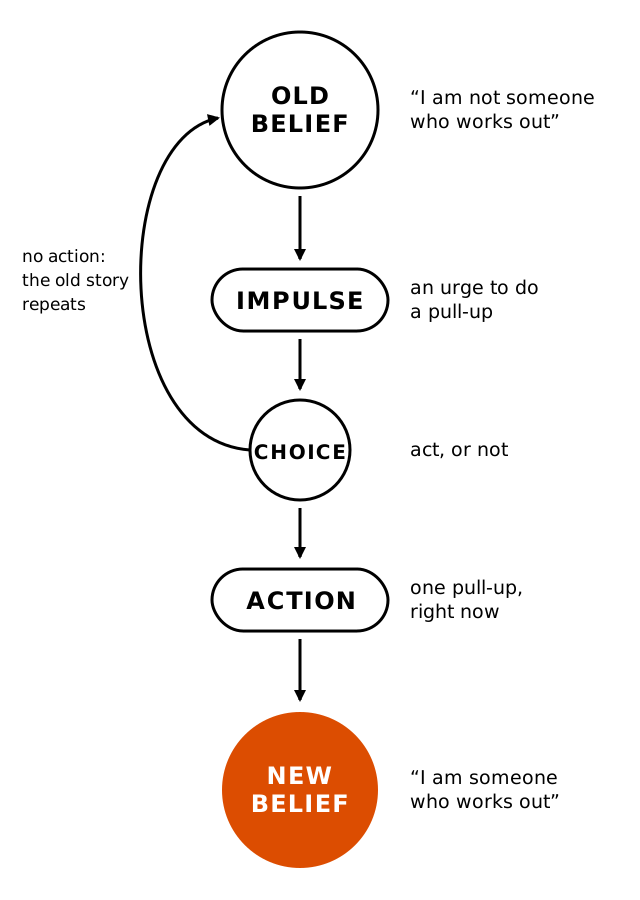
Here again is the Formula. No commentary.
Step 1
Act on your excitement, your passion, whatever is most exciting to you, in the moment. Do this every moment that you can.
Step 2
Do this to the best of your ability. Take it as far as you can go until you cannot take it any further.
Step 3
Act on your excitement/passion with absolutely no insistence, assumption or expectation of what the outcome should be.
Step 4
Choose to remain in a positive state regardless of what happens.
Step 5
Constantly investigate your belief systems. Release and replace the un-preferred beliefs: fear-based beliefs, and the beliefs not in alignment with who you prefer to be.
Excitement is the physical translation of the vibrational resonance that is your true, core natural being. Follow your excitement!
- Bashar
04
Discipline & The Path of Least Resistance
I'm sure you and I share some common experience when it comes to working out. You've probably started many times and just like me, the only thing that was really consistent with every attempt was the quitting itself. I'm also very confident that you, just like me, have heard many times that the answer to your problems is to have more discipline.
What if I told you the problem isn't your lack of discipline, but your definition of it?
We've been told that discipline is the key to success, in fitness and in life. And yes, the ability to stay focused on a task for a period of time is a genuinely useful skill. The modern version of discipline, though, the "push through, force yourself, no excuses" version, has the ability to create something very specific inside us. Resistance.
The more we push through something we don't enjoy, the harder it becomes to stay consistent. When we inevitably stop, we blame ourselves, thinking we just need more discipline. We try harder, fall off again, and the cycle repeats. Sound familiar?
I looked up where the word "discipline" actually comes from. It comes from the Latin disciplina, meaning instruction, teaching, devoted learning. And that comes from discipulus, meaning pupil, student... disciple. A disciple isn't someone who forces themselves to show up. A disciple is someone who is so devoted to what they love that showing up is simply what they do.
Discipline, in its truest form, is passion. We've just been handed a distorted version of it, one built on control and pressure instead of devotion and love.
If outdated discipline isn't the answer, then what is? The path of least resistance.
Now, when I share this idea with people, I sometimes hear: "Isn't that just being lazy?" Or, "Doesn't that mean working smarter, not harder?" It's actually neither. And before you dismiss this as some spiritual woo-woo nonsense, you should definitely hear me out. Let me explain through my own story.
As you know, I got deeply into golf. I mean deeply. I trained until my hands bled. I changed my entire swing from the ground up. I practised inside training facilities sometimes until midnight, not because I had to, but because I genuinely couldn't stop. I was having so much fun watching myself improve.
And as you know by now, those years led me to becoming a golf instructor and eventually competing on professional tours. From the outside, people would say "Wow, you're so disciplined." From the inside? It never felt like discipline.
That's the key. The path of least resistance has nothing to do with how much effort you put in. It has everything to do with how much you love what you're doing. The resistance I'm talking about is internal, the friction you feel when you're moving against your own nature. If I had applied those same hours of devoted energy to something like accounting, I would have burned out in a week. Not because accounting is wrong, just because it doesn't reflect my nature.
When people say "I'm not motivated," what they really mean is "I feel resistance." And it's worth asking, where is that resistance actually coming from? Sometimes the resistance isn't about movement at all. It's about the mismatch between what you're doing and who you actually are.
This is why micro workouts, and the spontaneous movement they're made of, can be so powerful. Not because they're easier, but because they remove the gap between the impulse to move and the act of moving. When movement becomes a natural part of your day, it stops requiring force. You just do it, because it feels like you.
And more importantly, if we know strength training is good for us, why wouldn't we be excited about it in the first place? I think I have come to the realisation that I am so passionate about living life, and that for me, living a passionate life means having a lot of energy and strength to carry out everything I wish to do. So strength training simply supports that life vision, hence the feeling of excitement I feel within when I am acting on it.
That's also part of the reason why I have come to the conclusion that true discipline isn't about forcing yourself. It's about being devoted to something you love, so devoted that consistency stops being a struggle and starts being an expression. As you may be starting to realise now, the question isn't about forcing yourself to do the workouts.
The question is how can you become so passionate about your life that strength training becomes the obvious reason for your own expression? Well, the book's purpose is not to answer that, but let's start to make it practical so you can work in that direction.
05
The 4 W's
Excitement isn't just about what you do. It's about the full picture. The environment around your movement matters more than you might think.
Let me show you what I mean.
I like strength training. That part I knew. But for years I kept losing momentum. Showing up to the gym, losing the spark, stopping. What I didn't realize was that I only had one piece of the puzzle. The What was right. The Where, the Who, and the When were completely off. That's what the 4 W's are: a simple way of discovering the full environment where movement actually comes alive for you. Think of it as widening your field of possibilities. The map serves the impulse, not the other way around.
What: the type of movement
Start here. What type of movement excites you most?
Do you like to push your limits: strength, intensity, challenge? Or do you prefer something slower and more mindful? Do you like to run or walk, dance, or stretch? Focus only on the movement itself. How does it feel in your body while you're doing it? How do you feel after?
For me, this changes depending on my mood, and I'm not limited to one thing. Sometimes it's bodyweight strength training or resistance bands. Sometimes it's running to get the heart going. Sometimes it's walking to reconnect with nature. And sometimes it's Tai Chi: slow, intentional movement to be in a state of flow.
None of these is more right than another. They're all just different expressions of the same source.
Where: the location
Where do you feel most inspired when you move?
Open sky, trees, fresh air? Or the structure and focus of an indoor space? The social energy of a gym? The silence of your living room? The sound of birds?
Your environment plays a huge role in your energy. Some people thrive around others. Some recharge in solitude. Neither is wrong. It's just information about who you are. For me, strength training happens mostly at home, though I'm flexible, and I always find a place to do a micro workout wherever I am if I feel the pull to do so. If I'm on a vacation I usually use whatever is available to use.
Running and walking happen in nature. Tai Chi is mostly at home, sometimes in nature.
Who: the company
Movement doesn't have to be a solo act. Sometimes the right person, the right energy, or even the right music can completely transform the experience.
Ask yourself: do you prefer to move alone or with others? Do you love the energy of a friend running beside you, or does that feel like pressure? Do you train better with music or in silence? Maybe you have a dog, and you can exercise together.
For me, most workouts happen alone, sometimes with my wife, and sometimes inviting friends for short outdoor runs adds something completely different. A companion. When you have a friend and you are on the same vibe, it can definitely expand the motivation and experience for both. Just bear in mind not to get too comfortable always depending on working out with other people. You might find yourself not training at all when you lack a partner.
Sometimes music and some dance moves in between my exercises play a huge role in my flow and overall experience. Most times I run without music in nature, but I love to have it for Tai Chi, dance and working out. Music is a great permission to allow the current vibe to express itself even more. It can also act as a trigger to get you moving.
When: the timing
At what time of day do you naturally feel inspired to move?
Morning energy or evening calm? Certain days of the week? Certain seasons? You might find that summer pulls you outside and winter pulls you inward toward something slower and more restorative.
This can change, and that's the point.
For me, I love to do slow free flow tai chi moves in the evening with music fitting to the movements. Mornings I sometimes do a few pull-ups and push-ups just to get my system started.
Take a moment and map your own 4 W's. There's a dedicated section in The Journal waiting for you. Don't worry if you don't have all the answers yet. That's exactly the point. Go experiment. Try something. See how it feels. Adjust.
The best way to use the 4 W's is to be completely honest. If you feel that you don't know the answers, it is your job to go and take action to find out. It's fun finding things out, right?
Let's connect in the Community
Before you move into the next chapter, come and say hello. All people who get access to the book also have access to the community. People share their journeys and experiences. It's also the easiest place to reach me directly, and where the live Zoom calls and the other fun things happen.
Make a post. Tell us who you are, and where you are in your journey right now. Looking forward to connect!
Before you move on
Thank you. That is genuinely useful.
Micro Workouts
"Your brain is not for thinking. Everything that it conjures, from thoughts to emotions to dreams, is in the service of body budgeting."
Lisa Feldman Barrett, The New York Times, 2020
01
Intro
As you may have gathered by now, this book is, at its core, a mental one. It operates from the idea that change starts from within. When we shift our beliefs and ideas about ourselves, our external world starts to adapt.
Even while we're working on the mental level, though, there are still some physical things we simply know are good for us. I believe most people on planet Earth already know that daily movement is essential for our wellbeing. It's well studied and well documented: people who are active on a daily basis live longer and feel better. It simply makes you more you, in a sense. I think you know that too. That's probably why you're here.
I'm sure you have your own history with exercise. I remember, as a child, playing on an ice hockey team. For some reason, whenever we trained cardio and went out running, it was so hard for me. I'd get pains in my belly, it felt like suffering. As I grew up though, I realised the problem probably wasn't running at all, it was my diet and what and when I ate before practice. Sometimes, just having the right information about what actually serves us is enough to point us in a better direction. These days, running is one of the easiest and most joyful things I know.
In this chapter, I'll explain the importance of daily movement, and specifically why strength training is so good for the human body, and why micro workouts make it even easier. I'll also show you my full setup. The final chapter is where you'll learn to perform the most fundamental exercises that build strength through the whole body.
I have a friend who told me he loves his gym because they have an app that tells you exactly what to do, which exercise, how long to do it, how long to rest, and when to move to the next machine. My first thought was, "Yeah, that's quite practical." Something about moving from machine to machine like a robot, following instructions, just makes me laugh though. It's really not for me. It would be like telling an artist to put down the brush and let AI do the painting instead.
When we create our own space, when we get creative about how we want to move and build an environment that supports our own expression, finding new ways to move becomes a creative process and that gives meaning to the experience.
Take my setup and this whole chapter as inspiration. Ideas to spark your own way of doing things.
Let's jump in. Let's inspire ourselves with just how good strength training is for the body, and how the body actually wants it.
02
Why Strength Training?
As I'm sure you already know, our bodies need some physical resistance in order to stay strong, and to grow stronger.
When I talk about physical resistance, I mean it as broadly as it gets. The gravity pushing you down on this earth is resistance. So is carrying your groceries, or walking up the stairs, or holding your posture. All of that is keeping you alive. Without it, your whole body would slowly melt like a candy.
Resistance is what builds your body, and we need it every day. Take it one level further and that is strength training.
Here are some reasons why strength training in particular is good for the human body.
Your muscles are already disappearing
Not when you're old. Not in your 60s. It starts in your 30s. Without any form of physical resistance, the average adult loses roughly 3 to 8 percent of their muscle mass every decade. The rate accelerates after 50. By the age of 70, science suggests most people have lost around 20 percent of the muscle they had in their twenties, and some up to 30 percent.
Here's the part that matters even more than the numbers: strength declines faster than size. You don't just lose muscle. You lose the functional capability that muscle gives you. The ability to catch yourself when you trip. To carry heavy things without strain. To get up off the floor. To stay independent.
A 2022 meta-analysis found that just 30 to 60 minutes of strength work per week is associated with a 10 to 17 percent lower risk of dying from all causes. And more than that didn't help further. The benefit peaked around the half-hour mark and then levelled off. Not hours in the gym. Thirty to sixty minutes a week. When you combine that with the idea of micro workouts, the effort you actually need to put in is, when you think about it, peanuts.
For most people, the version of themselves they most want to be is someone who moves freely through life, who plays with their kids without getting winded, who hikes without struggle, who feels capable and alive in their body well into old age. Strength training is simply one of the best answers to actually living that life.
The real benefit isn't how much you can lift. It's how much you have left over.
Think about the last time you felt genuinely strong. Actually capable and at ease in your body. When you're strong, by whatever "strong" means to you, daily life demands a smaller fraction of your total capacity. A long day at work doesn't leave you flat on the sofa by eight in the evening.
Research describes this as a safety margin above the threshold of disability. The stronger you are, the more room you have above what daily life actually requires. That room, that buffer, is what gives you energy left over for the things that actually matter. Strength training is not just about lifting heavier weights. It's about making daily life feel lighter.
So what kind of strength is that? This is where I think the gym gets it backwards.
When entering a gym, it's obvious that there is a machine for almost every muscle in the body. This is effective if your goal is to maximise each muscle separately, whether for muscle gain or for rehab. Many of the machines are designed to isolate the desired muscle so only that one gets the maximum load. Sounds good, right?
The isolated movements lock your body into a fixed path so that one muscle does all the work. A leg extension machine, for example, strengthens your quadriceps. Just that one muscle, in one direction, while the rest of your body sits still. That's useful if you're rehabbing an injury or you're a bodybuilder sculpting a specific look. Nothing wrong with it for those purposes.
But that's not how your body actually works in real life. When you pick up your child, carry groceries, climb a hill, or catch yourself when you slip on ice, no single muscle is acting alone. Your whole body is coordinating. Legs, core, back, grip, balance, all firing together, stabilising each other, communicating in real time. That coordination, that communication between muscles, is what makes you capable in daily life. And it's something a machine can't fully train, because the machine removes the need for it.
So the distinction is this: isolated strength is how much one muscle can produce on its own. Functional strength is how well your muscles work together as a system. For most people who aren't professional athletes or bodybuilders, the second one is what actually matters.
It changes your brain, not just your body
A meta-analysis in JAMA Psychiatry pooled 33 randomised trials covering 1,877 people, all of them structured programmes using weights, machines or bands. It found a clear reduction in depressive symptoms, and the effect held up in the trials with the tightest controls. A separate analysis by the same group points the same way for anxiety. And crucially, these effects were independent of whether participants actually got stronger. The act of training itself was enough.
What the research shows about confidence is worth sitting with. The confidence that comes from strength training doesn't come from how you look. It comes from what you can do. From mastery. From lifting what was once impossible and feeling your body respond. From proving to yourself, repeatedly, concretely, unmistakably, that you are capable. People who get physically stronger report feeling like a more capable version of themselves.
A stronger body breaks less
Stronger muscles protect your joints. Stronger tendons handle force better. Regular loading keeps the whole system more resilient over time. The strongest evidence is for chronic back pain and knee pain, two of the most common complaints in modern life. Science suggests both improve with progressive strength training. Not because pain is always caused by weakness, but because a stronger body has more capacity, more protection, and more room to move without strain.
So why strength training?
It makes daily life feel lighter.
It builds the kind of confidence that comes from knowing what your body can do, not how it looks.
It sharpens the mind, lifts the mood, and keeps the whole system running better. A strong body simply has more to give, more energy, more resilience, more capacity for the things that actually matter.
Two months into running with a weight vest and doing squats and deadlifts with my resistance bands on a regular basis, I noticed a huge difference when carrying my kids up our three-story stairs. It was simply… easy!
03
Why Micro Workouts Work
First, something to be clear about. The classic gym model, three times a week, an hour or two per session, genuinely works. If you love it, if it fits your life, if it lights you up, keep doing it. This isn't here to tear that down. It's here to show you that it was never the only way, and why, for a lot of people, a smaller and more frequent approach fits real life better.
Why most people quit has nothing to do with laziness
Why do so many people quit within the first few months? A big part of it is something called activation energy, how much effort it takes just to begin. Changing clothes, commuting, deciding what to do, committing to a long block of time, all of that is start-up cost. When life gets busy, which it always does, the first thing to go is usually the thing that takes the most effort to start. Behavioural research points in a consistent direction here: the harder a behaviour is to begin, the less likely it is to happen. The easier it is to begin, the more likely it gets repeated, often enough to eventually feel automatic. So we can all relax the motivational playlist on Spotify and the two cups of coffee.
This is where micro workouts have a real advantage. The barrier to starting a ten-minute session at home requires far less activation energy. No preparation, no commute, no social pressure. You just start.
What is a micro workout, actually?
You've had the loose version of that since the first chapter, mostly measured in minutes. Here's the precise one, because the difference matters, and the minutes were never the point.
The traditional definition of a micro workout is when someone takes a full workout, let's say six sets of push-ups and squats, and divides it into smaller chunks spread across the day. That's one way to look at it, and it works. My definition is a bit more loose.
For me, a micro workout is any time you act on an impulse to move in a way that's out of the ordinary and takes some kind of effort. It could be a stretch. One pull-up. A few seconds of balancing on one leg. It could be two or three push-ups followed by a ten-second plank. To me, all of it counts. The point isn't the size. The point is that you moved, and you did it because something in you wanted to.
The effort you put in is yours to define. Three push-ups might be nothing to one person and the most they've asked of their body all year to another. You get to choose what effort means to you.
The research on home-based exercise leans the same way: people with equipment visible and accessible at home tend to exercise more often than those who rely on going somewhere. Proximity and convenience aren't just practical advantages, they're part of how habits form. Bringing the movement into your home drops the activation energy at the source.
Small starts build faster than big ones
Small starts aren't a motivational trick. They seem to be closer to how habits actually build. A single pull-up because you walked past the bar counts. Repetition, in a stable context, is what lays down the pathway over time. Small and often seems to stick better than big and rare. That's my whole story, twice. A swing rebuilt a few reps at a time, and strength built a few pull-ups at a time.
Roughly, this is what's happening in your brain. Each time you complete a small session, there's a little dopamine, the direction signal we talked about earlier. Doing something small, often, seems to help the brain lay down that pathway faster than doing something big, rarely. The more frequently you repeat it, the more the habit strengthens. And this part is worth being clear about, because it's where a lot of people get discouraged: what your brain is building a habit around is the act of showing up to move. That's different from the movement getting easy. The habit can be forming, you're reaching for the pull-up bar without thinking about it, while the workout itself still feels hard. That's completely fine. The effort staying challenging isn't a sign it's not working. It's a sign you're still doing real work. Two different things are happening: the habit is getting automatic, and the body is still being asked to work. Both are supposed to be true at once. Your brain doesn't seem to build habits from big occasional efforts so much as from small, consistent ones.
While we're here, one myth worth retiring: the idea that it takes 21 days to form a habit. That number came from a plastic surgery book written in 1960 and has nothing to do with movement. What replaced it isn't much firmer. It's more likely to take around two months, and some behaviours and patterns can take up to eight months before they fully change. And missing a single day doesn't reset anything. Occasional lapses don't derail the trajectory. What matters is returning, being able to comeback. Personally, I can have a week or two of doing nothing. It has happened a few times during the last three years. Especially with kids bringing every flu home from kindergarten. It doesn't matter, a day here, a week there. Once I felt better and the spark was back, starting again was always fun and felt uplifting. There were even times when I was sick and I longed to get back to my micro workouts.
Micro workouts aren't a compromise
What about the body itself? Because this is where a lot of people assume short sessions must be a compromise, and the research is more encouraging than that. One study had three groups train for very different session lengths over eight weeks, and the strength gains came out remarkably similar across all three. That's one study, not the final word, but it points to something the fitness world often skips: strength seems to respond more to the quality of effort than to the length of the session. What seems to drive the adaptation is the quality of the effort, not the clock.
Then there's energy, and this one's simple. A long, heavy session leaves many people flat for the rest of the day. That's completely fine if training is your main commitment. Most of us have kids, work, relationships, a whole life that also needs energy though. Short sessions tend to give you the stimulus without the depletion. You finish and feel better, not wrecked, still able to show up for the rest of your day.
Finally, the part most people never stop to consider: moving every day isn't strange for a human body. It's closer to normal. For most of human history, people moved constantly, building, carrying, walking, working, not in three scheduled sessions a week. Our bodies seem built for regular, everyday movement. In that light, micro workouts aren't a shortcut. They're a return to something natural.
Now let's go through my setup at home, and you'll see that needing a lot of tools and machines isn't the answer to living a life full of movement.
04
My Setup
I'd rather have one tool I can use for the rest of my life, doing many different things with it, than have ten tools standing still in the basement collecting dust.
Sometimes our mind wants us to believe that it will be easier to start if we just have the right tools. I can tell you for certain, and this comes from someone who used to believe exactly that (spoiler: it's me), it doesn't work like that. As we've already discussed, what we really need is to act as that version we want to be. And that version is doing what? Moving. In other words, the act of starting a micro workout, or just doing three push-ups right here and now, will bring you further than reading this book, feeling inspired, and ordering $2,000 worth of tools online.
For me, I have two tools that I use all the time. Two things I've come to love. They're really my good friends, and we always have a great time together.
The first is a pull-up bar. One bar, one movement, and most of your upper body is working at once. Your back, your arms, your grip and your core all have to cooperate to get your chin over that bar, which is exactly the cooperation a machine takes away from you. And for me, it gives a great feeling. It's fun being able to pull my head above my shoulders.
I also came to find out that when you do a pull-up and pull your legs in front of you (a little bit is enough), you activate the core at the same time. This exercise is so effective, it's like doing a plank and a pull-up at once. Sometimes, out of nowhere, I see my pull-up bar and I just do one or two, because it's so fun!
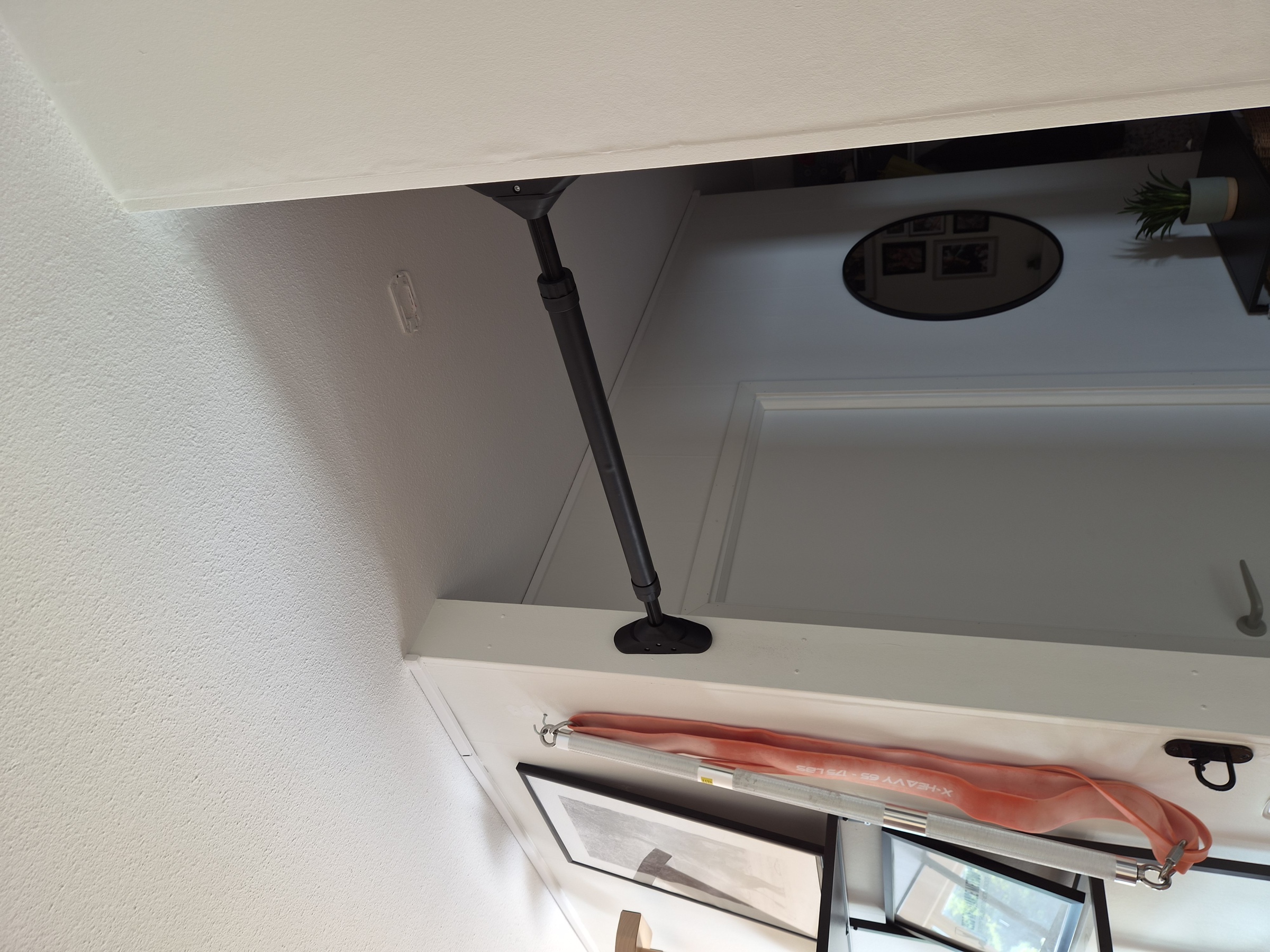
Now, you might feel devastated. Maybe these movements were hard for you from an early age, and it awakens memories of not being enough. If that's you, it's completely fine to feel that way. I just want to encourage you: with a new way of thinking and starting, you can definitely learn to do a pull-up. In fact, I'm confident enough to say that every human who doesn't have some constraint, disability, injury, or similar can learn to do one. As long as you're capable of moving your shoulders and arms, you can do it. We'll go through this in more detail in the final chapter, on how to do the different exercises.
My second love is my resistance bands. I love them. The reasons? First: they're versatile. I can do many different exercises with a single band, and I can bring them anywhere in my backpack. Second: they're very friendly toward the joints, since you start with less load and it builds up through the movement. With my resistance bands, if I'm creative, I can create positions and movements with real load. And this isn't just me talking myself into it. Researchers have pooled the trials comparing elastic bands against machines and dumbbells, and neither came out ahead on strength gains. The band in my backpack does what the room full of machines does.
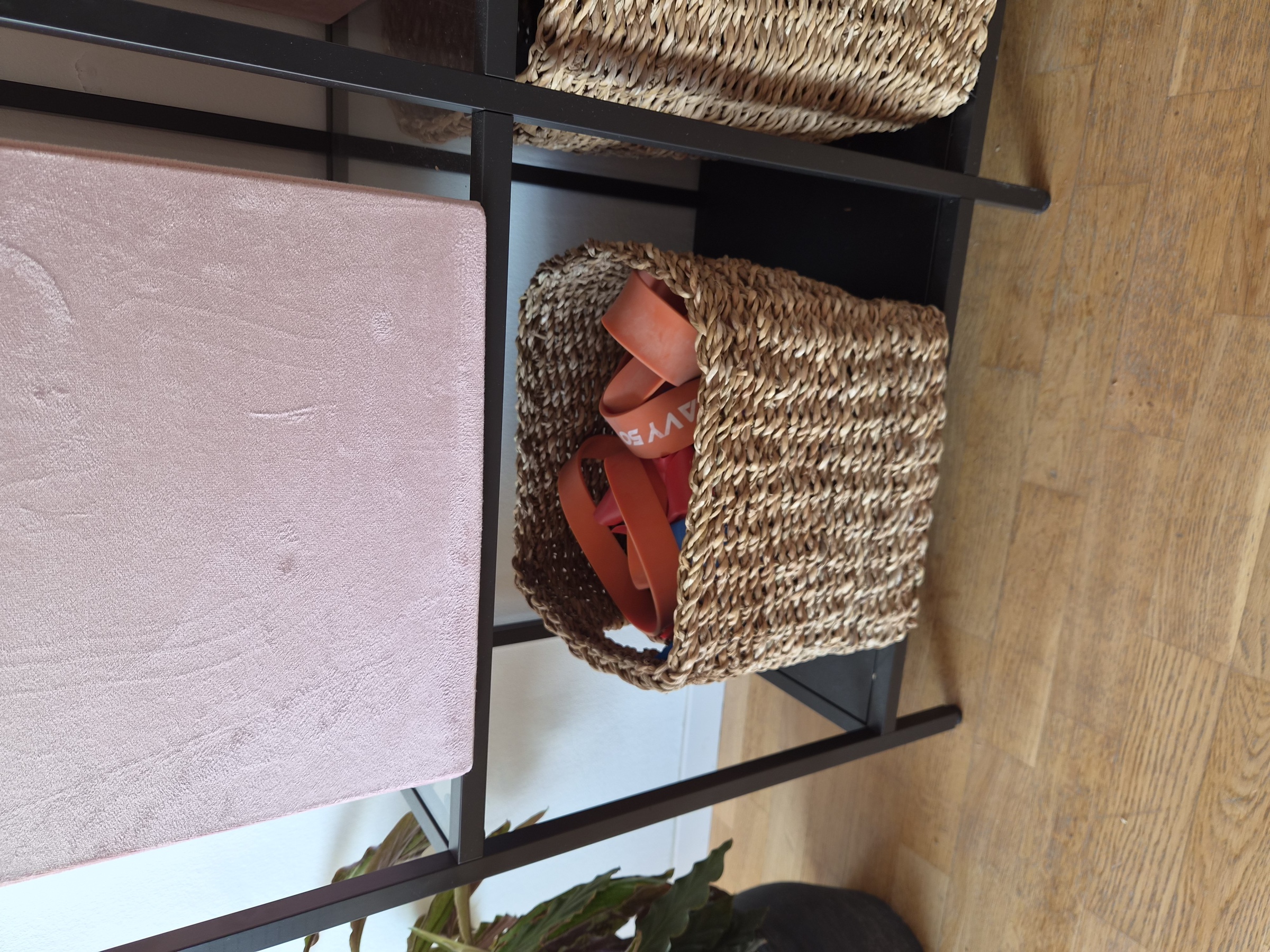
Along with my resistance bands, I also have a bar that I can connect to them. This way, the bar acts like the bar you would use at your gym for bench press, squats and so on. I use it very often, but I only use it for one exercise. And it's probably one of the most important ones.
Deadlift. With this tool, I can add a huge amount of load, and get a very effective and safe movement to strengthen my lower back and glutes. I use it as a bench press standing up too, but rarely.
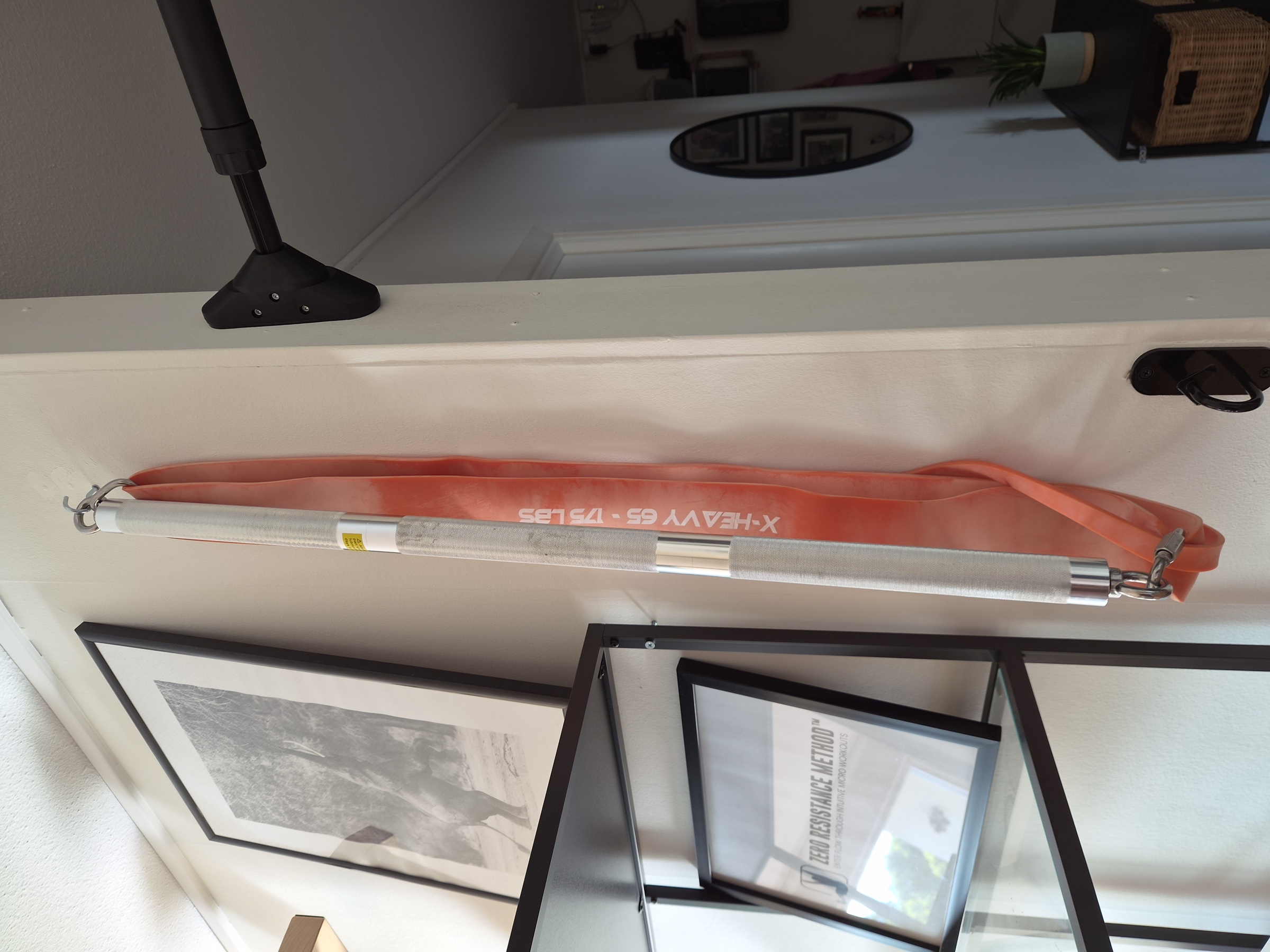
My next tool, which I also use regularly but not as often as the first two, is my parallettes. To me, they represent the next level of training, and they're associated with calisthenics, a word that comes from the Greek kállos (beauty) and sthenos (strength): "beautiful strength." Which is a fine representation of what can happen when you use your own bodyweight as an instrument. The parallettes have handles, which give you a better grip, so you can put the body in more challenging positions than you could with your hands flat on the ground. They're a great tool if you have stiff wrists or pain, since the grip distributes the force differently than flat hands do. The exercises I use most often with the parallettes are handstands and push-ups.
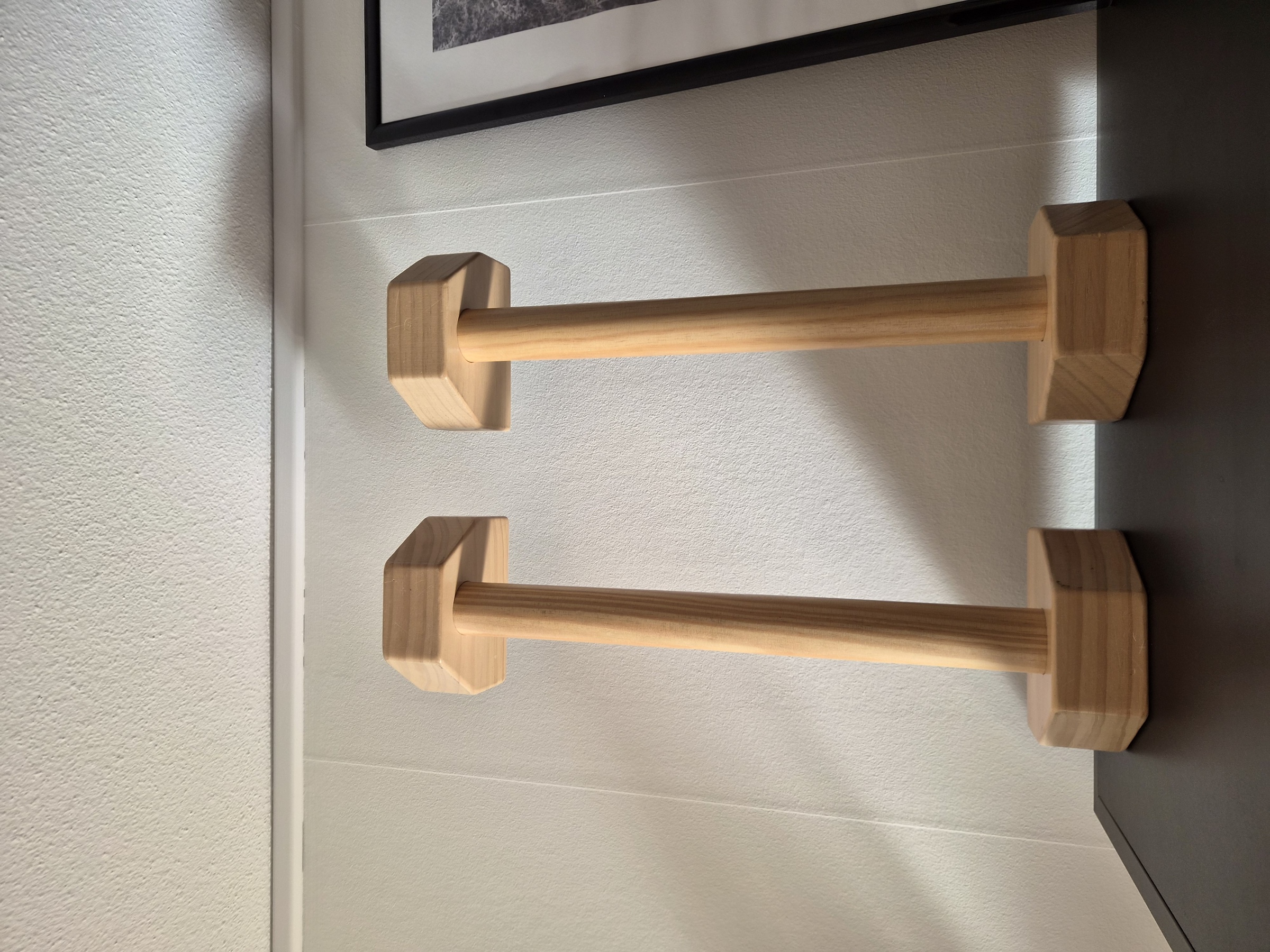
Once I became stronger using the pull-up bar and the parallettes, I realised I needed more load if I wanted to keep getting stronger. That's when I decided to buy a weight vest. I'd say it was a great investment. I can put it on easily and quickly, do a few different exercises, and it's very effective. The one I use can be adjusted up to 15 kg. I also use it for running.
I love running in a small forest next to where I live. It's quite hilly, with ups and downs. This is actually a great way to add strength to the legs and glutes. Then I got curious whether it would be more effective to run with the weight vest. Oh boy, it sure is. Instead of running longer distances, I prefer to run a bit shorter, three to five kilometres, and instead of flat ground, I run in the forest. I always end my run with two or three sprints up a steep hill to really get the heart pumping.
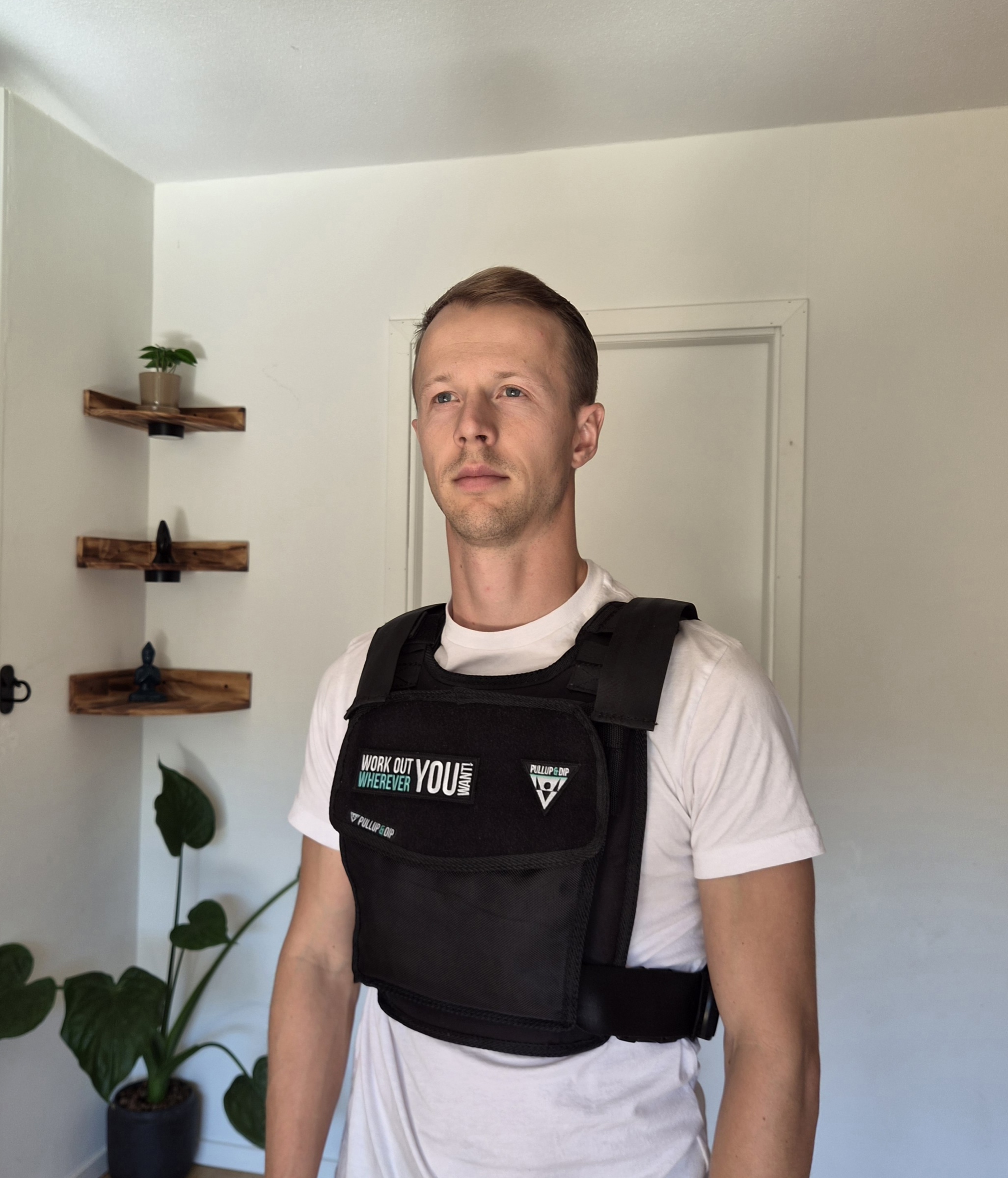
Besides these, I have one pair of dumbbells that I've had since I was seven years old, each weighing 4 kg. Somehow they've always been around, and I'm surprised I still have them. I use them once in a while for some shoulder exercises.
I also have two rings for grip strength, and don't underestimate them. Grip strength is one of the strangest findings in this whole field. A study followed almost 140,000 people across 17 countries and measured how hard each of them could squeeze. Years later, the ones with the weakest grip were the most likely to have died. Grip strength turned out to predict that better than blood pressure did. I don't think a strong hand is what keeps anyone alive. What I think is that your grip is a good measure of how strong the whole body is, and a stronger body is a healthier one. That said, working with a pull-up bar will give you a lot of grip strength training without needing another tool, so I only use these once in a while.
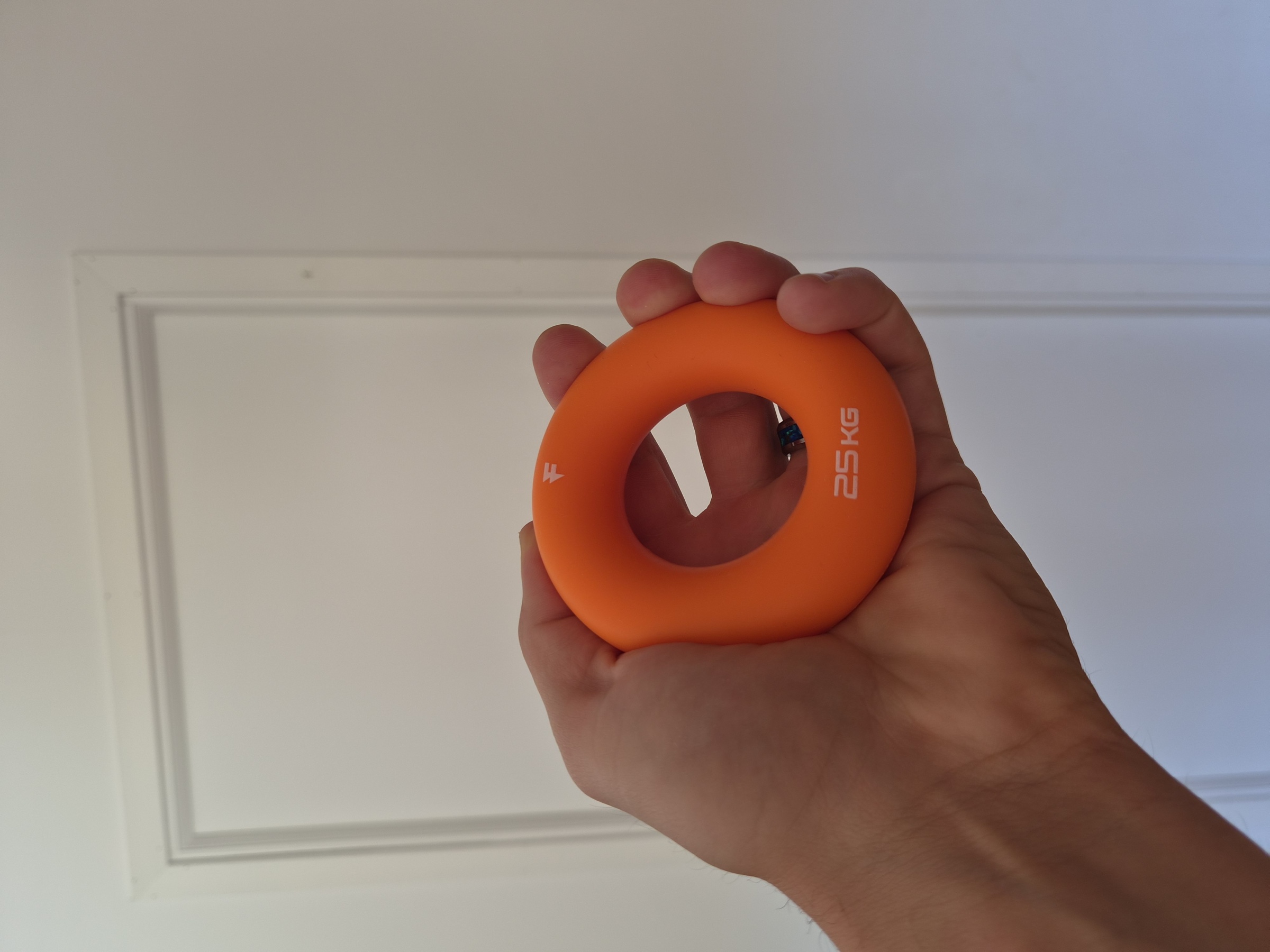
The last small tool I have is actually a little rubber thing you can bite on. Somehow, it can be very satisfying to bite down and train the muscles in the face during a session. It feels like there is some tension stored in the face, and biting kind of releases it. Same as the last one, once in a while, whenever I feel called to use it.
This is my setup. Yours doesn't have to be the same. I'm showing you simply for inspiration.
A general rule of thumb is to have fewer tools, especially when you start. I'd suggest building a positive association with one tool, and creating a process where it's fun to use. That matters more than having the ones you think are the "right" ones. My recommendation is to pick the one that sparks the most within you, and go with that. If you feel called to add more because it feels like an extension of the excitement you've already built, then add more as time goes by. Having too many tools can create a low-level stress that they "have" to be used, and when one isn't, it creates unnecessary unease.
Another great thing about having your tools visible is that they remind you of the person you want to be. And to be that person, the only thing you need to do is use them.
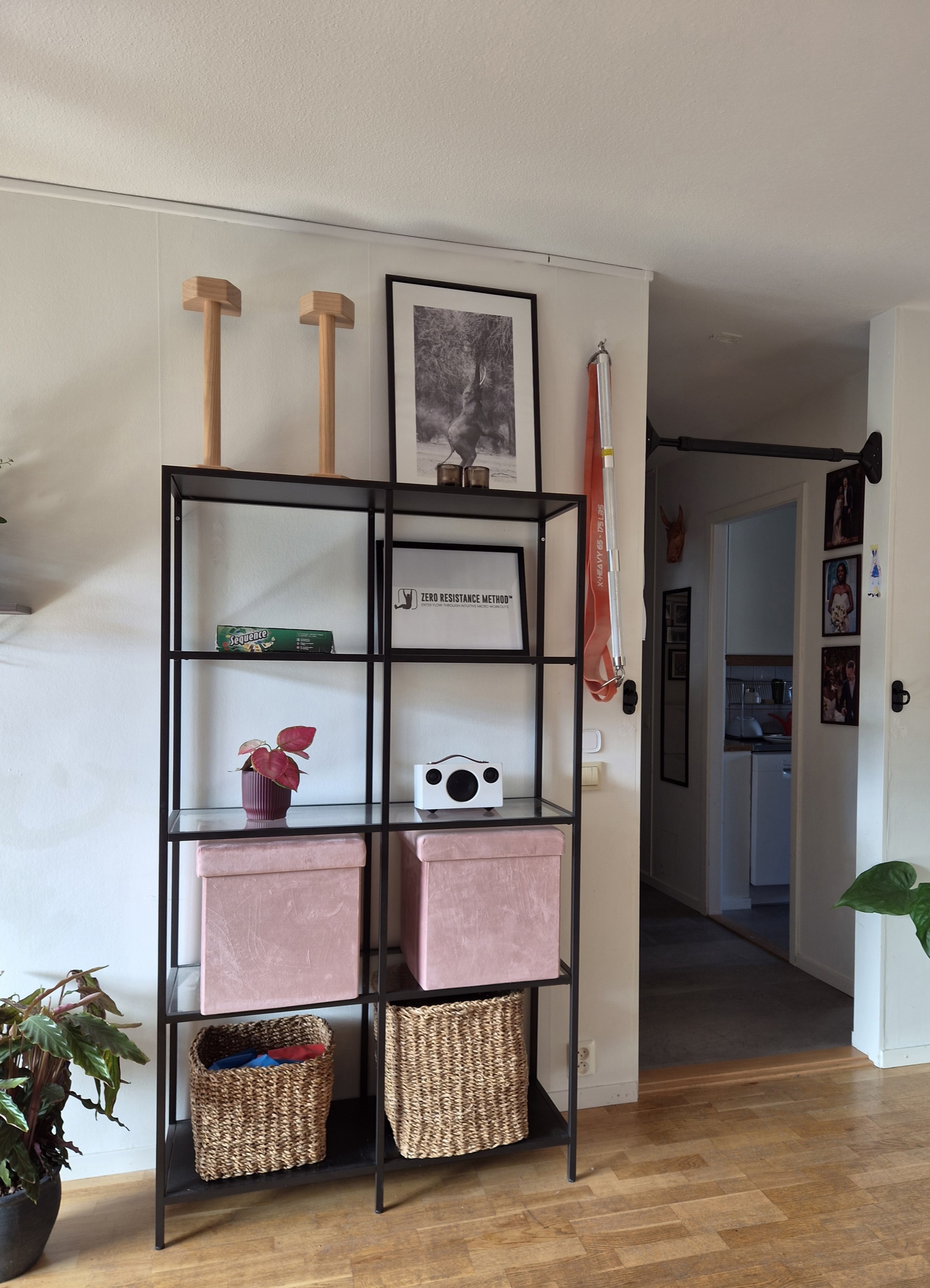
As you can see from my setup, all the tools that I have shown you are visible in this picture, and this is just a small section, one corner of my living room, and that's it. It doesn't take up much space. It's seamlessly integrated into the room, and it reminds me daily who I am and who I want to be.
And then there are my two favourite weights. You won't find them in the photo.
My daughters are usually playing in the living room when I start a micro workout, and it doesn't take long before they want to join in. When I do pull-ups, they sometimes ask me to lock them in with my legs, so when I pull myself up, I pull them up too. When I do push-ups, one of them climbs onto my back. When I do squats, I put them on my shoulders. And sometimes we drop the workout altogether and just play. I'm a spider, down on all fours, chasing them around the room.
For them, it's play. For me it's play too, and it's also training, on purpose. They love it, and so do I.
In chapter 6 there will be a dedicated video section on exactly this: playing with your kids as a micro workout.
Let's talk more about how the tools can trigger and remind you.
05
Do You Feel Triggered?
"Any exciting goal will arrange exciting ways to achieve it."
Bashar
There is a Chinese art called Feng Shui. It's the idea that you can arrange the furniture in a room to create a better energy (chi) flow. And thinking about the teaching of choosing passion over resistance, it's the same idea. Going with the flow, rather than against it.
Interestingly, Feng means wind and Shui means water. The idea being that wind and water are what shape the landscape.
Just as we learn to go with our inner flow, we also need to adjust our outer space to allow that flow.
When creating your setup, the single most important attribute, in my opinion, is that whatever object you relate to movement is visible. And that there's room for you to move around, lie down, or do whatever you need in order to do the movement you prefer.
Once the object is present, it's up to you to decide what relationship you want with it. Hopefully it becomes a companionship, where you use the object often and start to shape a habit with it. And in turn, that object becomes a trigger for you to take action.
Sometimes when I walk into my living room, I just get this feeling of doing some pull-ups. I don't get it in the bedroom or the bathroom. I get it walking into the living room, because that's exactly where my pull-up bar is placed. I literally pass under it many times a day. And more importantly, I use it. There's no hesitation, no thinking, when I decide to take action. It just is. It has become so normal for me to do pull-ups that whenever I'm at a playground, or anywhere with a bar or something close to one, I do a few. It's fun!
And just as water and wind shape the landscape, the pull-up bar is shaping me too. It strengthens me, refining my body, and continually showing me that I am capable. An active, moving human.
This is the kind of relationship I'm talking about. What can happen when we really start to use ONE thing often. With time, and many small starts, we build an established foundation where choosing movement is frictionless. And by one thing, only using your body still counts.
Now, what objects can be a trigger? Well, theoretically, any object can. Maybe even a poster of Arnold Schwarzenegger posing could be enough to get you going.
My point is: it can be anything, and I don't know what yours will be. Here are a few that trigger other people I know. A pull-up bar in a doorway you walk through, a yoga mat left unrolled on the floor, running shoes set beside the bed. Those are the obvious ones, physical objects you see and respond to.
It can also be less obvious than that. One person I came across painted a section of their wall a specific colour that, to them, meant movement, and just seeing that colour became the reminder. For others it's a routine: making a cappuccino at home is the signal that a micro workout comes next. The coffee becomes part of the ritual, not separate from it. It can be a time of day or maybe a specific song. The trigger doesn't have to be a piece of equipment. It just has to mean let's get moving.
Some triggers aren't things at all. One movement can be the reminder for the next. I've gone straight from pull-ups into push-ups so many times that now, whenever I do a pull-up, it reminds me of the push-ups too. It's not that I always choose to do them. The reminder comes, and I choose in the moment.
This is usually how a longer workout starts for me. I feel I have energy, so I do some pull-ups and go straight into push-ups. Then I take my bar and do some deadlifts, until I'm out of juice and I can feel my heart pumping. I go and relax, drink some water, do some work. Then I come back, see the pull-up bar again, and do the whole sequence again. Maybe once more after that. One movement became the trigger for a whole sequence.
Movements you're already making can work the same way. I have kids, so I'm often down on the floor picking up after them. Sometimes that's my reminder: I'm already down there, so I do a few hamstring stretches. Or when I reach for something high up, I go up on my toes, squeeze my glutes and stretch through my whole body to reach as far as I can. It becomes a stretch and a strength exercise at the same time.
There are many ways to do this, and you can get very creative with it. And the beauty of it is that you never have to think about doing these stretches. They simply happen as part of your life.
The trigger itself matters less than the relationship you build with it. At its core, it's a representation of you. And that's the whole point of this journey. To become the version of you that says, with confidence, "I am movement." Because you are. You can move. And that's when movement stops being something you do, and becomes who you are.
06
Test Your Feelings
Writing this book has been a challenge for me. It hasn't always come easy, or it has taken longer than my impatient mind anticipated. There have been times when I literally believed I cannot write. Even when I believed that, though, I always had a strategy to see if it was true. Test it!
Let's say I have a thought that "man, writing is so hard and I don't know how to finish." The first thing I would do when an opportunity arose was to test and see if that is true. Is writing really that hard? Sometimes I just wrote for the sake of writing. Not to produce, just to prove. "Hey, you are actually doing it." "It's easy." The more I did this, the easier it got with time. And as I continued, I usually got to a point where I felt finished with a chapter, and I moved on to the next one.
The same goes for your stories and thoughts about what it means to do a workout. When I had a gym card and had to commute to the gym to get my workout, I now look back and realise that many times, my thought pattern was usually around the whole effort it took to finish. Let's say I felt a little bit tired. I had planned the previous day that today I would go to the gym, but I wasn't really feeling it. So I had thoughts that would project that feeling. "Nah, you don't have to go today, today you are a bit tired, better rest." And I usually believed it. The thing was, testing if that was true would mean that I would have to push through the whole effort of going there, doing all my planned sets, and going back home.
Now that micro workouts are how I move, and my setup is right there, it's very easy for me to test if I am really up for it or not. If I feel tired, but yet there is something in me to do some pull-ups, I put it to the test. Maybe I will get something going, or maybe not. When I challenge my thinking and feelings, I don't deem them as true or false when I get them. I first try them with action. Sometimes I do get momentum and do a few more. Sometimes I stop and just say, "no, I am actually really tired," and then I simply rest.
I think this is one of the core reasons why I haven't quit doing my micro workouts since the beginning of 2023. It's not because I got a stronger will or became mentally tougher. It's simply easier to test myself with something small than to face the weight of a whole gym session.
Part of why the answer changes day to day is that your body isn't the same every day. It moves through rhythms, across the day, across the seasons, and for women, across the month. Energy rises and dips for real physiological reasons. That winter heaviness isn't laziness. That afternoon strength isn't imagination. You don't need to study any of it. You just need to know it's there, so that when the test comes back "not today," you can take that as your body's rhythm talking, and rest without arguing about it.
Before you move on
Thank you. That is genuinely useful.
The End Is The Start
"The curious paradox is that when I accept myself just as I am, then I can change."
Carl Rogers, On Becoming a Person, 1961
01
What It Could Cost You
When I think back on how many times I started swearing on the golf course because it didn't go the way I imagined, I immediately start to laugh. The laugh is good though, because it means I don't regret it or feel ashamed. Though, it still leaves me with one question.
I wonder how it would have been if I had chosen otherwise when not living up to my expectations?
Thinking deeper about it, how many rounds could I have enjoyed with friends, asking them the deeper questions of life, or just talking about nothing and everything. Yet I walked around being mad. Mad at this shot, mad at the next. Mad for not scoring enough, mad for not being good enough.
When I had my second child, I stopped playing golf. Life was simply too busy, and I wanted to prioritise my family. When the kids got a little older, I started playing again. This time, I'm a dad of two, and I have no plans of making a living playing golf. I'm not the same person I was when I quit.
This time, I told myself, from now on I will have a different relationship to golf. It doesn't matter how I play. The only thing that matters is that I find enjoyment in just being on the course. Being in nature, meeting new people. I get a funny visual that if an old wise man had stopped me and shown me how much it cost me to almost always being mad and too competitive. And then shown me how life would have looked if I had calmed down and enjoyed what I was doing. Hell, I was playing golf for a living. Firstly: I would have played better golf. Keeping the emotional side steady and calm is essential for a comeback to turn the play around. Secondly, lifelong friends I could have made if I had been more focused on the people I was playing with. I'm sure that if, in that moment, I had both timelines and all the information, I would have changed my attitude for good. As I said in the beginning, looking back at it I am laughing, because now I have changed, so lesson still learned.
One thing before you do this. I am not asking you to scare yourself. Any fear that shows up belongs to your beliefs, not to the exercise itself. The cost is simply real, and many people only change course once they let themselves see clearly how their life would actually look, and what the impact would be, if nothing changes. For a lot of us the good version alone does not land. We need to understand what the other one really means to us. When the whole picture is in front of us, it's most often easier to see clearly and to choose from a wider perspective.
If you think about where you are in your life now, and you imagine two different versions of yourself playing out. How would you look when you got older? How would your health be if you were the person who said, "Nah, working out is not for me"? How would your body hold up? Would you be sick? Complaining about your pains?
And the second version, the one who said, "I am someone who loves to move," and decided to act as if that were true, for the rest of their life. What would that version look like in older age? Being able to play with grandkids? Having fun doing activities like hiking?
Just imagine what it could cost you, choosing the version you couldn't see clearly.
Even though this story isn't a tragedy or something horrible. It shows my point: even if we feel stuck, or unlucky, we can change the narrative and turn it to our advantage, giving the power back. As Bashar beautifully put it: "Circumstances don't matter, only my state of being matters."
This goes for movement too. It doesn't matter where you are. Even if you have never done sports or set foot inside a gym, you can still start now and benefit from it. Whatever disadvantage you believe you have, you can change the narrative into something positive, and that changes what you go looking for. And what you go looking for is what you eventually find.
02
Allowing Yourself to Be
What I do believe is worth taking with us is that we can have periods, for whatever reasons, where we simply have to allow ourselves to just be. I had a friend who visited an Indian guru and went through some kind of deep inner-work ceremony. When we met up afterward for an event where both of us were supposed to lead our own workshops, he told me he had been by himself for weeks. He felt emptied out. He didn't know who he was anymore, and he wasn't sure he had anything to give. He was told by all workshop leaders that you don't need to do anything unless you want to. He sat with that for a while, and then he decided to do his event. Afterward, he told me he was glad he did. Not because he forced himself, but because from the stillness, from the not-knowing, something new had come through that he couldn't have planned.
That's what I've come to trust about doing nothing. Sometimes, taking time to just be without wanting anything can lead to great insight and clarity about what to do next. The same goes for movement. Sometimes it can be beneficial to do "nothing" for a while, and then from that nothingness let something new emerge.
One of the biggest beliefs I dropped when it comes to movement and exercise is the idea that I "have to" do something. If I genuinely feel I don't need to do anything for a while, it doesn't disturb me, because I know there will come a time when I am full force again. I simply put my trust in that knowing and allow myself to be.
03
Self-Worth
Bashar has a great saying: "The only thing you discover in the unknown is more of yourself."
Sometimes, we fear digging deeper because we believe we will only find more pain, though that is most often not true. In order to transform pain into a new expression and fuel for our growth, going deeper into the unknown is highly beneficial.
Do you remember what we said about beliefs, how a belief works like a lens, quietly shaping how we feel, think, and act? Well, here's what I've come to see: self-worth isn't some separate thing with its own rules. Self-worth is a belief. One single, specific belief, maybe the deepest one we carry:
"Am I worthy to be fully myself, and to accept myself exactly as I am?"
Yes or no?
That's it. That's the whole structure. Whether we call it self-acceptance, self-love, or confidence, underneath all those words sits this one question, and the answer we're carrying around.
Here's how you'll know your answer, not by thinking about it, but by feeling what happens when you ask it. If you feel doubt, a hesitation, a tightening somewhere, then it's a no, or at least not yet a full yes. If you feel recognition, a warmth, an excitement, a "yes, that's me, I am worthy, I can feel it", then it's true. It's a yes. The feeling is the answer, and your body doesn't lie.
Psychology actually has a name for the doubt, for the "yes, but only if I look a certain way," the "yes, once I've earned it." They call it contingent self-worth, and the research points consistently in one direction: worth that's staked on how you look or what you achieve rises and falls with every result. It works as fuel for a while, but when the fuel runs out, the action fails too.
That doubt becomes the lens: it shapes the feelings, the thoughts, and the actions that follow, exactly the way every belief does.
Which means something hopeful, too. Because if self-worth is a belief, then everything you already learned about beliefs applies to it. It can be seen. It can be questioned. And it can be changed.
Where does the answer we carry come from?
A lot of it, I believe, comes from an early age. When we're young, we soak up not just what people say, but how they act, how they feel, how they treat themselves and the world around them. If the people we loved were stressed, angry, or afraid, we often absorbed that too, not as information, but as identity.
Long before we could question any of it, we were already learning. From what made the adults around us light up, and what made them go quiet. From what earned us warmth, and what earned us distance. This is how the foundation of our self-worth gets built. Not from logic. From experience.
And specifically, how were you treated? When did the praise come, the warmth, the play? Was it only when you were a good boy or a good girl, when you achieved something, when you behaved? Or did they play with you, praise you, love you, simply for being you, with no reason needed?
Before you start mapping your childhood onto your destiny, though, let me say something important: conditioning is real, but it is not an equation.
Because here's what I know to be true. There are people who grew up with every disadvantage, with parents who never believed in them, never saw them, maybe even actively suppressed them… and they still became remarkable. Successful, kind, free. We've all met someone like this, or read their story. If conditioning were a simple equation, bad input equals bad output, these people couldn't exist. And yet they do.
There is clearly something in us that can override the conditioning. You can call it will, you can call it soul, you can call it the divine, you can call it the universe, you can call it biology, you can call it randomness. Whatever it is you believe in, we have a support mechanism that sends us information, wisdom and direction. I know it is there because I use it all the time, and I see it in other people too.
Just because you were conditioned does not mean you have to stay that way. What was learned through experience can be relearned through experience. That is not wishful thinking. It is true from both sides: from the scientific side, the brain can rewire itself for life, and from the deeper side, we have a will. And where there is a will, there has always been a way.
When I was younger, I loved to express myself and dance, the way most children do. I moved freely and joyfully. Then somewhere in my teens, all of a sudden, it felt weird. What was weird about me? Why couldn't I dance like I used to? Why was I scared?
Growing up, I was the one who dared to express myself openly, without fear of being different. Other kids took advantage of that. Maybe they laughed. Maybe they rolled their eyes. Maybe they left a comment. Nothing too dramatic, but with time, I started to believe the narrative they were putting out.
By the time I was a young adult, I felt insecure in my own skin, and I only danced when I was drunk and everybody else was doing it. Which is the funny part. I could deadlift 100 kilos and still go completely stiff when someone put on Beyoncé.
We learn early on that some expressions of who we are bring love, while others bring rejection. We suppress the parts that once caused us pain, often so deeply that we forget they exist. Even if we forget, though, the imprint remains, shaping how we move, how we hold our bodies, and how freely we allow ourselves to be seen.
And I also have another example that ties directly to movement. There was a time when I was about 10 kilos heavier, strong, defined, and walking around like I had it all figured out.
I wasn't confident because of how I looked. I was confident because somewhere along the way I had given myself permission to feel enough. My worth was never in my muscles. It was in what I believed about myself.
When I believed my worth came from my body, I only showed up when I looked a certain way. When I realised I was worthy regardless, I stopped trying to earn acceptance and started simply being myself.
I later found research pointing the same way. Researchers studied nearly a thousand regular gym-goers and found the same pattern: those who already felt at peace with their bodies had the most natural, self-sustaining drive to move, while those training to finally feel worthy were the most likely to burn out and quit.
What would your movement look like if you fully accepted yourself? If you didn't need to prove anything, not to anyone, not even to yourself?
I believe, with my whole heart, that we are all enough just as we are, and I will always believe this to be true. If we all truly believed that, there would be no need to push anyone else down, no need to act mean or make someone feel small. Because that impulse only comes from someone who doesn't feel enough themselves.
Next time you look in the mirror, asking yourself "Do I look fit?"
Try "Do I allow myself to be free?"
04
There Are No Musts
If you have read this whole book, tried the tools, taken it as far as you possibly can, and landed on the fact that strength training is not for you, that is completely fine. Not everyone needs to lift anything. There are many ways to give your body resistance. Some people play sports. Some cycle every day. Some walk. Some carry things. Some build things. All of it counts.
What matters is that there is movement. That is our nature. We are designed to move in physical reality, and very few of us came here not to. Almost everyone who is capable of moving benefits from doing it daily.
Health is a state of being. And it has a lot more to do with what we believe about ourselves than the activity itself.
If you found value and meaning through this book, I am extremely excited to hear your thoughts about it. Please leave some feedback in the community. I read everything, and I am more than happy to hear from you.
Before you move on
Thank you. That is genuinely useful.
The Exercises
Coming soon: video tutorials on how to do the most effective exercises at home, using only a few tools.
Everything before it stands on its own, so read it as a finished book with one chapter still on its way.
This is the first version, and only a handful of people are reading it. I am genuinely curious what it did for you. Did the teachings feel useful? Was there something that stood out? Is there anything you would want me to explain further, or go deeper into? Every detail is welcome, however small it seems.
One last thing
Thank you. That is genuinely useful.
Birk Bergdahl. First reading edition, September 2026. Chapter six to come.